
Against Entropy
Why the AGI race may be solving the wrong puzzle — and what four billion years of biology can teach us about intelligence
I want to start by saying something this whole essay depends on. I admire all three of the people I’m about to discuss. Marc Andreessen, Demis Hassabis, and Peter Thiel are each doing serious thinking about what is, in my view, the most important question of our era: what is intelligence, and how much of it can we build?
This essay isn’t a takedown. It’s an addition. Each of these three is pointing at something real. Each is seeing one face of the same larger object. I want to suggest, with the most respect I can muster, that there’s one more face they haven’t fully named yet — and that naming it changes how we should invest, build, and think for the next decade.
Let me start with what each of them is saying, because it’s more interesting than the caricatures.
What Andreessen sees
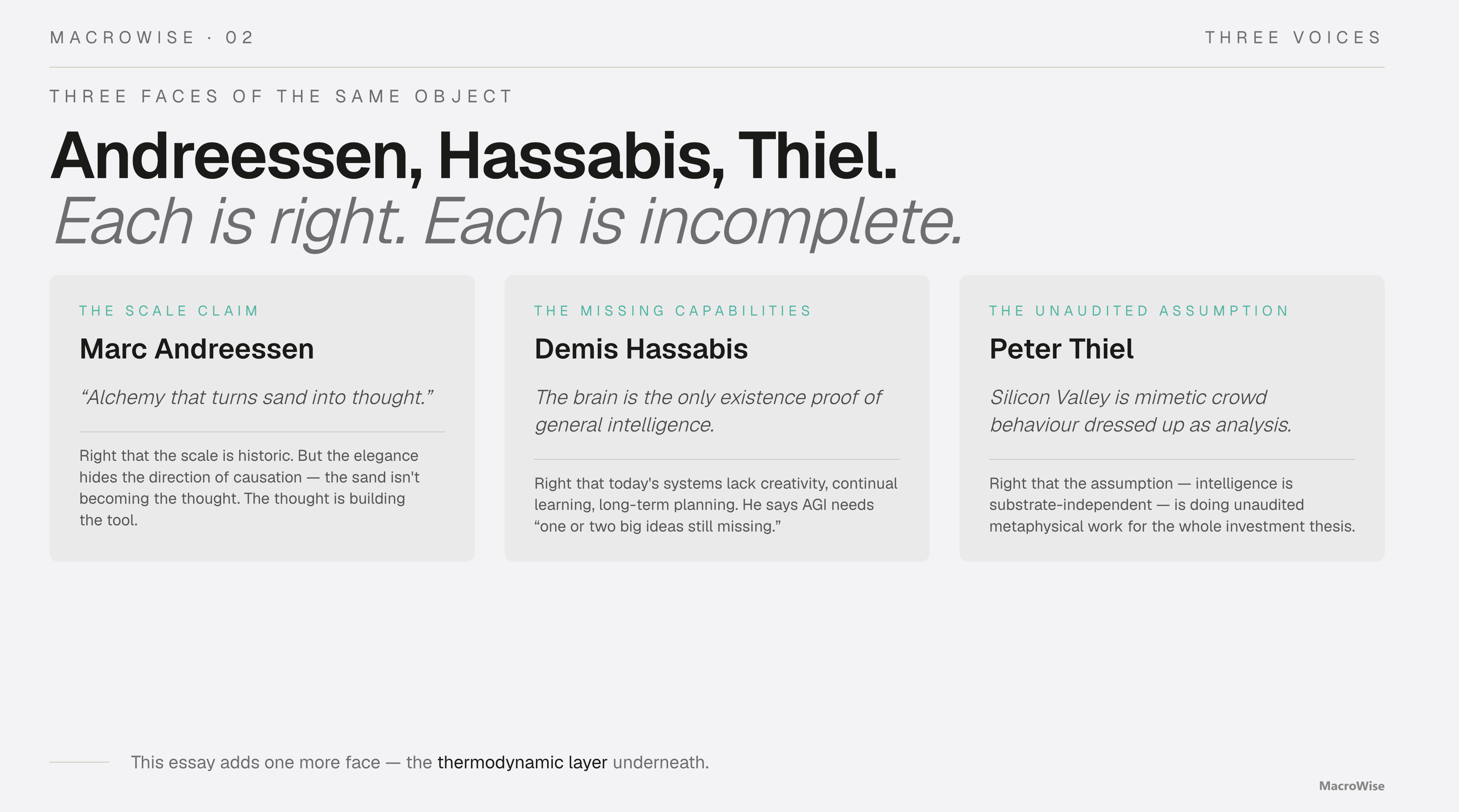
On Joe Rogan’s podcast last week, Marc offered a sentence so elegant it has already entered the canon: “imagine a form of alchemy that turns sand into thought.” Sand becomes silicon. Silicon becomes chips. Chips fill data centers. Data centers, fed enough electricity, run AI. And that AI now produces something that looks a lot like thinking.
He’s right that the scale is historic. He’s right that almost nobody outside Silicon Valley understands how big this is. What I want to add is that the elegance of the sentence hides the direction of causation. The sand isn’t becoming the thought. The thought is building the tool.
What Hassabis sees
Demis won the Nobel Prize in Chemistry in 2024 for AlphaFold and runs Google DeepMind. He has been saying something quieter, more careful, and in my view more accurate. He defines AGI as a system that can exhibit all the complicated capabilities humans can. He spent twenty years studying the brain because, as he puts it, the brain is the only existence proof we have, maybe in the entire universe, of general intelligence.
He’s honest about what current systems cannot do: true creativity, continual learning, long-term planning, consistency. He proposed the Einstein Test — could an AI trained to 1911 derive general relativity by 1915? His answer: today’s systems cannot. He thinks AGI is five to ten years away, requiring “one or two big ideas still missing.”
I think Hassabis is right, and I want to add the deepest physical reason he’s right — one I don’t think anyone has named quite this way yet.
What Thiel sees
Peter has been arguing for years that Silicon Valley is engaged in mimetic crowd behavior dressed up as analysis — that the whole industry is racing toward the same target without examining whether the target is well-defined. He sees the AGI race as a kind of religious movement, with its own liturgies and its own unexamined assumptions.
He’s right that the assumptions are doing work nobody is auditing. The biggest unexamined assumption is the one Andreessen’s alchemy sentence quietly smuggles in: that intelligence is a property of information processing, independent of the substrate doing the processing. If that’s true, sand-into-thought is possible. If not, the entire AGI investment thesis is built on a hidden metaphysical claim.
The layer underneath
What I want to add to the conversation is a layer that connects all three. The connecting layer is thermodynamic. It’s older than AI, older than neuroscience, older than evolution. It’s the second law of thermodynamics, and the way life uses fractal geometry to fight it across nine nested dimensions of organization. Once you see this layer, Andreessen’s scale claim, Hassabis’s missing capabilities, and Thiel’s mimetic warning all become three faces of one underlying picture.
Let me show you the picture in plain English.
The arrow points the other way
Andreessen’s chain goes from a dead substance up to thinking. Run the actual history of thought in the universe and the arrow points the other way.
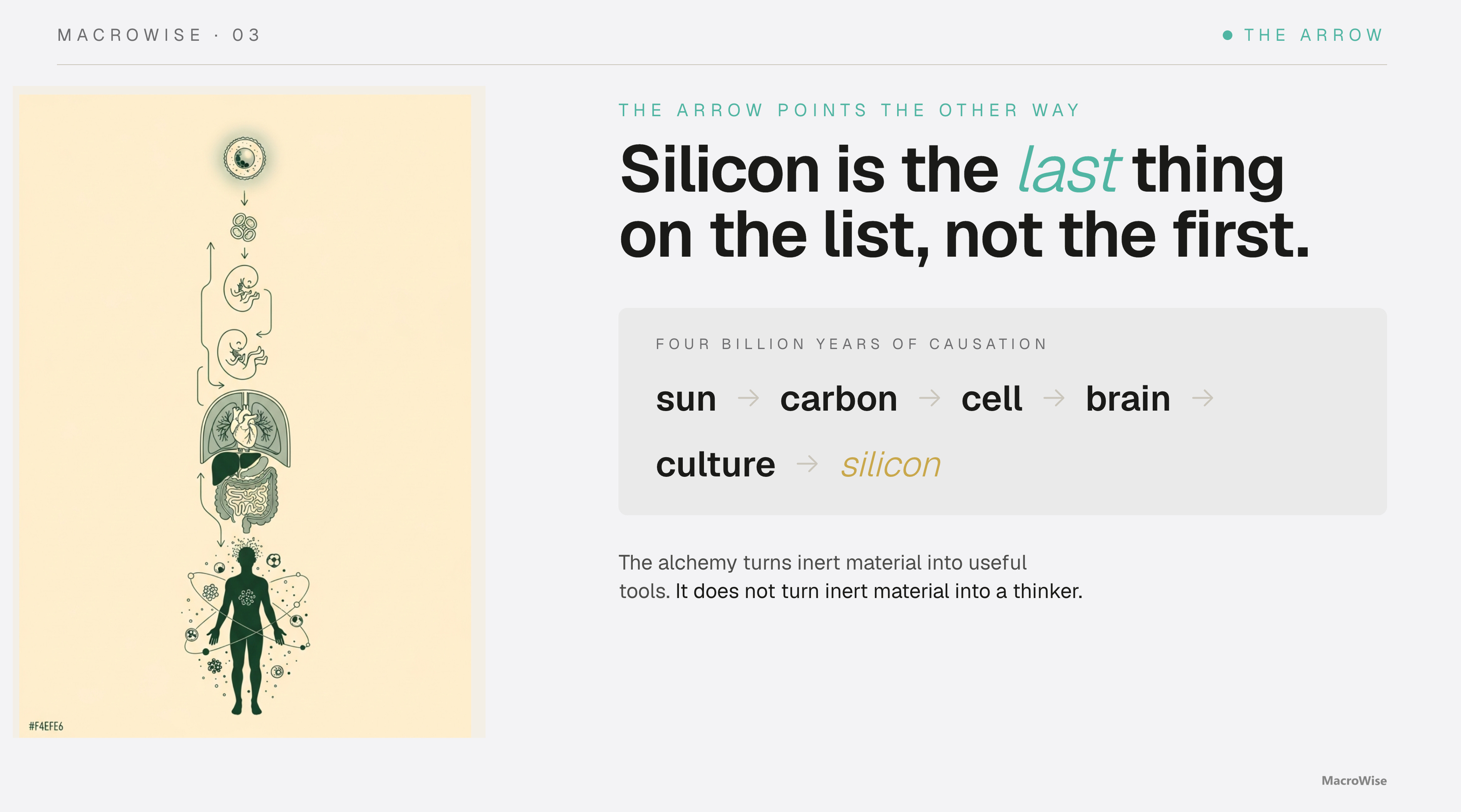
Stars made carbon. Carbon, mixed with water on a small planet, made cells. Cells — after almost four billion years of trial and error — made nervous systems. Nervous systems made minds. Minds made civilizations. And civilizations, in the last eighty years, made silicon chips.
sun → carbon → cell → brain → culture → silicon
Silicon is the last thing on the list, not the first. This isn’t a criticism — Andreessen’s sentence captures something true about industrial alchemy. But the alchemy turns inert material into useful tools. It does not turn inert material into a thinker.
Why carbon and not silicon
Silicon sits right below carbon on the periodic table. Same number of bonding arms. So why did life choose carbon?
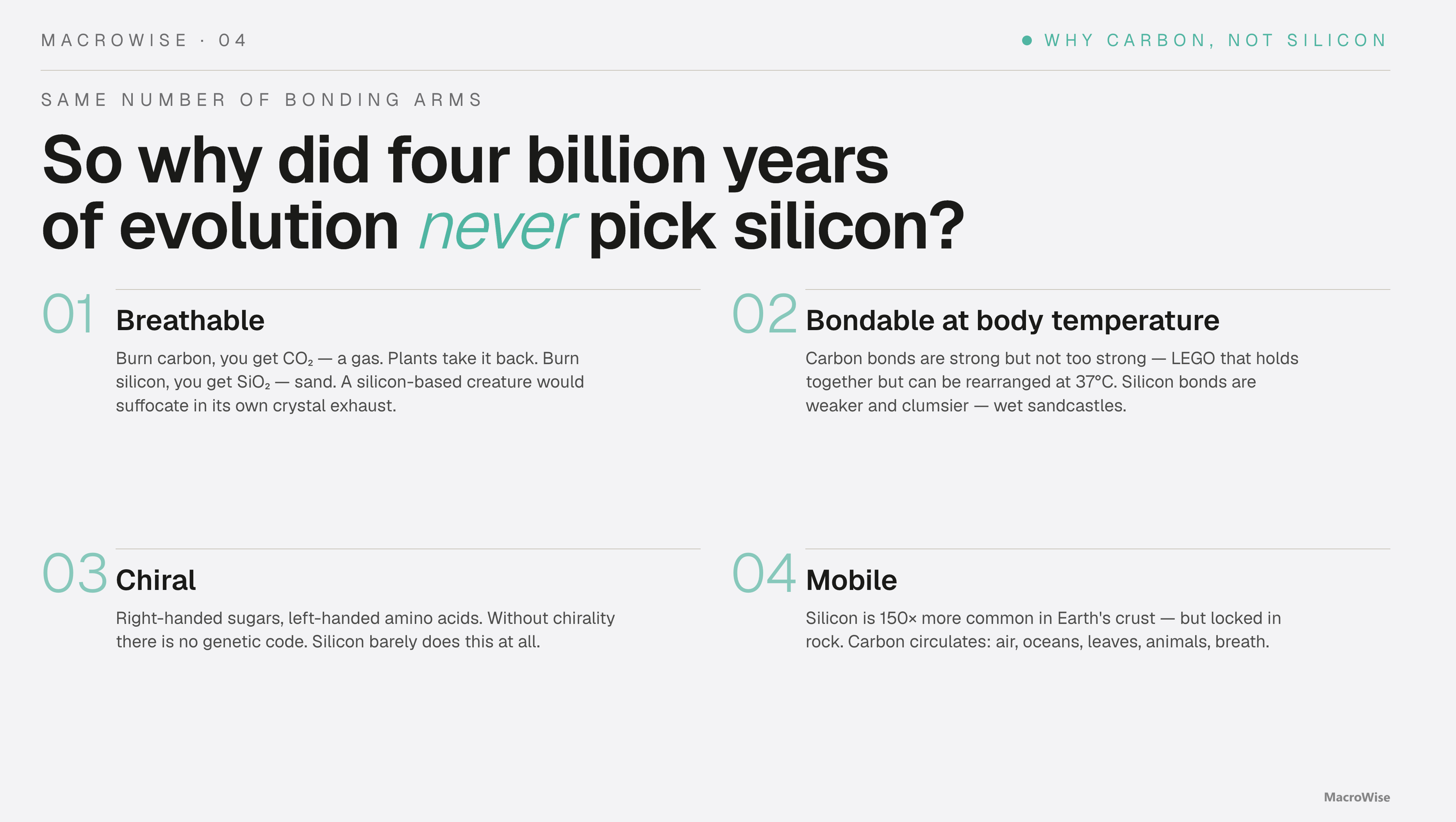
You can breathe carbon. You can’t breathe silicon. Burn carbon, you get CO₂ — a gas. Plants take it back. Burn silicon, you get SiO₂ — sand. A silicon-based creature would suffocate in its own crystal exhaust.
Carbon bonds are strong but not too strong. Like LEGO that holds together but can be rearranged at body temperature. Silicon bonds are weaker and clumsier — wet sandcastles.
Carbon lets you tell your left hand from your right. There’s a property called chirality — from the Greek for hand. A right glove won’t fit a left hand. Carbon molecules have this same property. All your amino acids are left-handed. All your sugars are right-handed. Silicon barely does this. Without chirality, there’s no genetic code.
Carbon moves. Silicon is stuck. Silicon is 150× more common in Earth’s crust, but locked in rock. Carbon circulates — air, oceans, leaves, animals, breath.
What real minds can do that AI can’t
Build themselves. A single fertilized egg becomes a brain with 86 billion neurons. No engineer. No factory. Just sunlight, food, body temperature. To make one modern chip you need silicon purified to nine nines, a $150 million EUV machine, vacuum emptier than space, a thousand factories across four continents. The chip cannot make itself. It is made. And the maker is always carbon.
Want to live. Here’s the deepest sentence in this essay: if something is genuinely intelligent, it will try to stay alive. Being intelligent means modeling the world and predicting consequences. The first inference any thinking creature has to run about itself is: I have to still be here tomorrow if anything I do today is going to matter. A real mind, by the act of being a mind, ends up wanting to continue.
Living things didn’t derive this. Every ancestor of every living creature wanted to live, because the ones who didn’t have descendants. The desire to stay alive isn’t a feature added on top of life. It is life.
A chatbot doesn’t want to live. It generates the next word. You can shut it down mid-sentence and there’s nothing in there to mind. Hassabis himself, racing to build AGI, has never claimed AGI will have this. He claims AGI will match human cognitive capabilities. He doesn’t claim it will have human stakes. The distinction is his.
Whatever doesn’t care if it’s switched off is not really intelligent. It’s a calculator with very good vocabulary.
The stack that fights entropy
Now the deepest idea. Everything above has been individual observations — carbon is more efficient, carbon builds itself, carbon wants to live. They sound like three different points. They’re not. They’re three faces of one underlying law. Once you see the law, the argument stops being an opinion and starts being physics.
The universe rewards systems that can travel across dimensions of network organization, because that is the only known way to fight entropy.
The second law of thermodynamics says everything tends toward disorder. Hot things cool. Organized things fall apart. The universe is sliding toward heat death.
And then there is life.
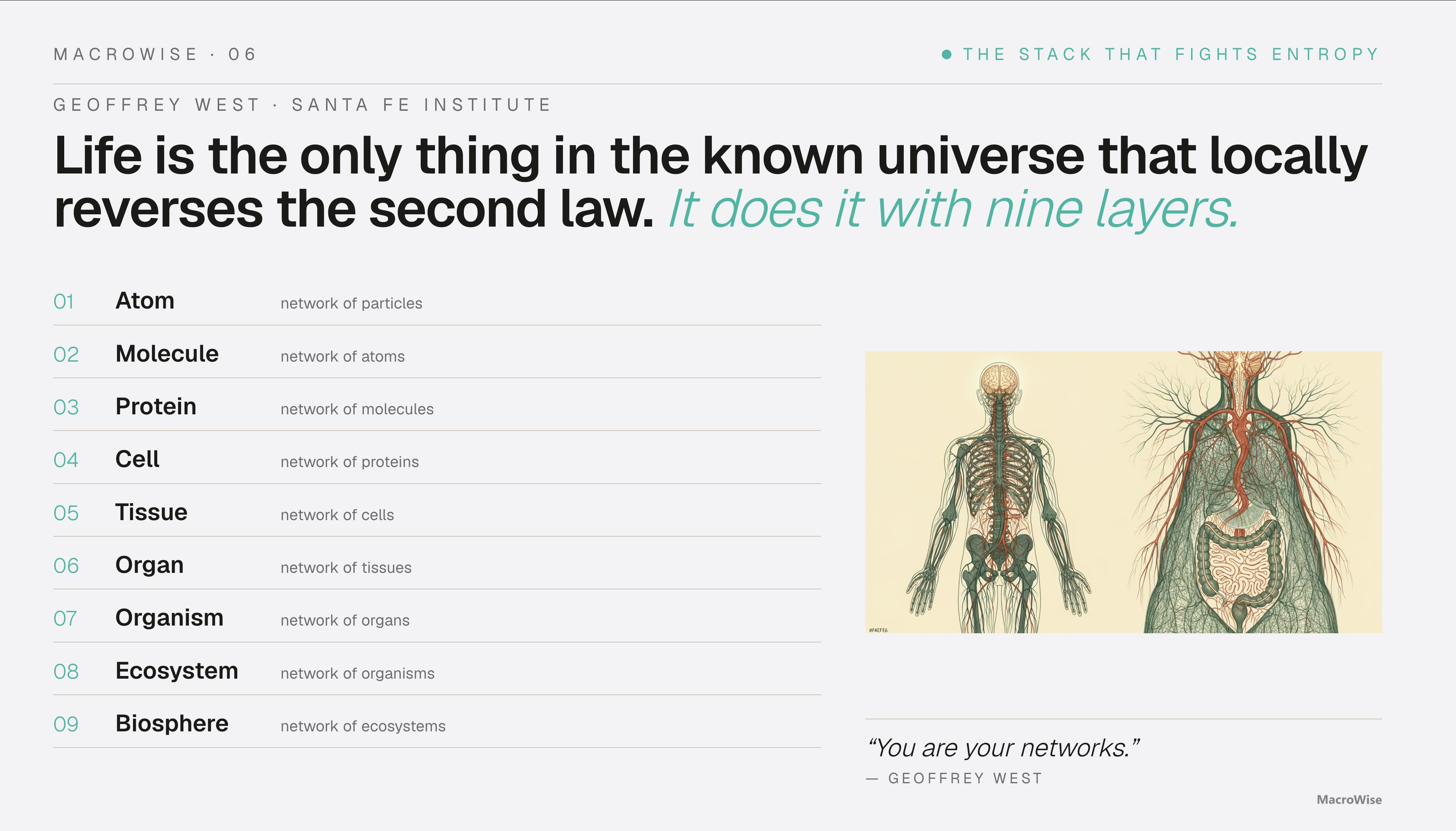
Life is the only thing in the known universe that has figured out how to locally reverse this. Not globally — the sun is paying the bill. But locally, inside the boundary of a cell or a body, life keeps building order while the universe outside keeps tearing it down. How? Through a stack.
Geoffrey West, the physicist who discovered Kleiber’s Law and runs the Santa Fe Institute, has spent twenty years showing that the same scaling laws appear at every level of biological organization. Capillaries inside your body branch like streets in a city, like mycelial networks under a forest, like trade routes in a global economy. Same math, every scale.
A stack. Layer upon layer. Each layer is a network. Each layer is itself a node in the network above it:
An atom is a network of particles
A molecule is a network of atoms
A protein is a network of molecules
A cell is a network of proteins
A tissue is a network of cells
An organ is a network of tissues
An organism is a network of organs
An ecosystem is a network of organisms
A biosphere is a network of ecosystems
Nine layers. Each fractally branched. Each using sublinear scaling so that bigger is more efficient. Each feeding the next. The whole stack fights entropy — not any single layer.
“You are your networks.” — Geoffrey West
You are not a thing. You’re a stack of networks. Pull any one layer out and the whole thing collapses.
Now look at silicon. A transistor is a switch on a 2D wafer. A chip is a flat grid of transistors. A server is a flat rack of chips. A data center is a flat warehouse of servers. Four layers. All flat. None branch fractally. None nest as “things inside things inside things.” They’re stacked like pancakes — each connected to the next by wires, none growing into the next.
The carbon stack has nine layers. The silicon stack has four. The carbon ones branch into each other. The silicon ones don’t.
Carbon stacks nine. Silicon stops at four. That is the whole asymmetry, in one sentence.
Every additional dimension of network organization gives you another way to fight entropy. Another way to dissipate heat. Another way to recycle materials. Another way to compress information.
Life is winning against entropy because it has nine ways to fight it. Silicon has two, sitting flat, and loses 40% of its energy budget to cooling because it can’t handle heat any other way.
And here’s the deepest point. The reason carbon “wants to live” isn’t philosophy. It’s thermodynamics. Wanting to live, in the deepest physical sense, is the act of pushing back against entropy across all nine layers at once. The “will to live” is just the integrated felt experience of all nine layers fighting at once.
Silicon can’t want to live because silicon doesn’t have nine layers fighting in concert. It has a couple of flat layers, and they don’t care.
Intelligence is not what brains do. Intelligence is what nine layers of fractal network look like from the inside, when the top layer becomes complex enough to model itself.
This is what I want to add to the AGI conversation. The current investment thesis is implicitly trying to build the top layer without the eight underneath. Like trying to build a tower starting from the roof.
The numbers
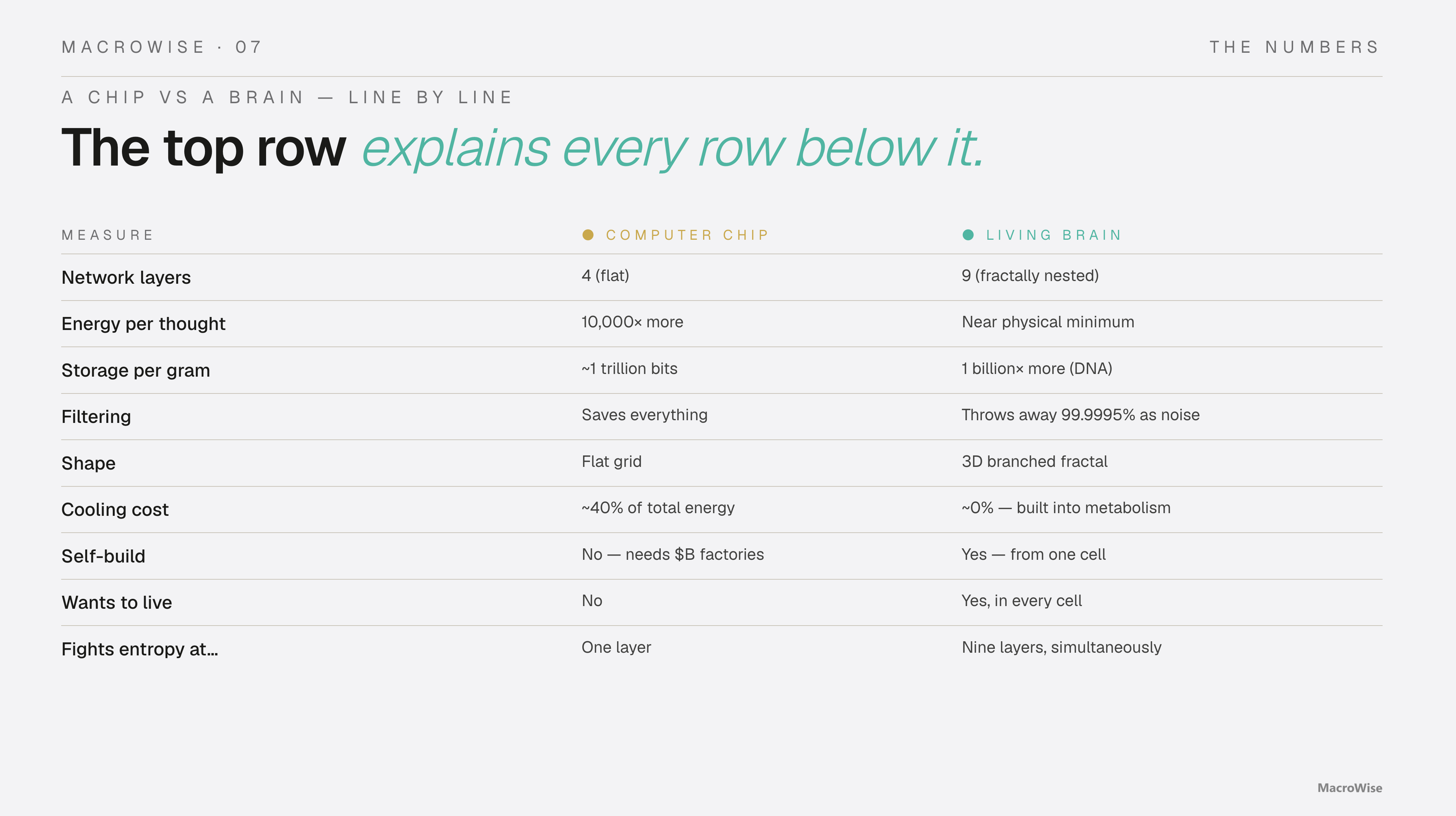
The top row explains every row below it. Carbon is more efficient because nine layers share the work. It stores more per gram because nine layers means more places to put information. It self-builds because lower layers automatically construct higher ones. It wants to live because all nine are fighting entropy together. The rest is downstream.
Jensen Huang has said the quiet part out loud on the same Rogan podcast: energy, not chips, is now the real limit for AI. Tech companies are ordering their own nuclear reactors. The IEA expects data center demand to nearly double by 2030. This isn’t an industry about to break through to cheap, smart intelligence. It’s an industry running into the wall that says: you cannot fight entropy efficiently from inside two flat dimensions.
You are already a superorganism
You are not one creature. You are about 77 trillion of them, working together. 37 trillion of your own cells. 38 trillion microbes in your gut — your “second brain” — producing most of the chemicals affecting your mood. 2 trillion immune cells.
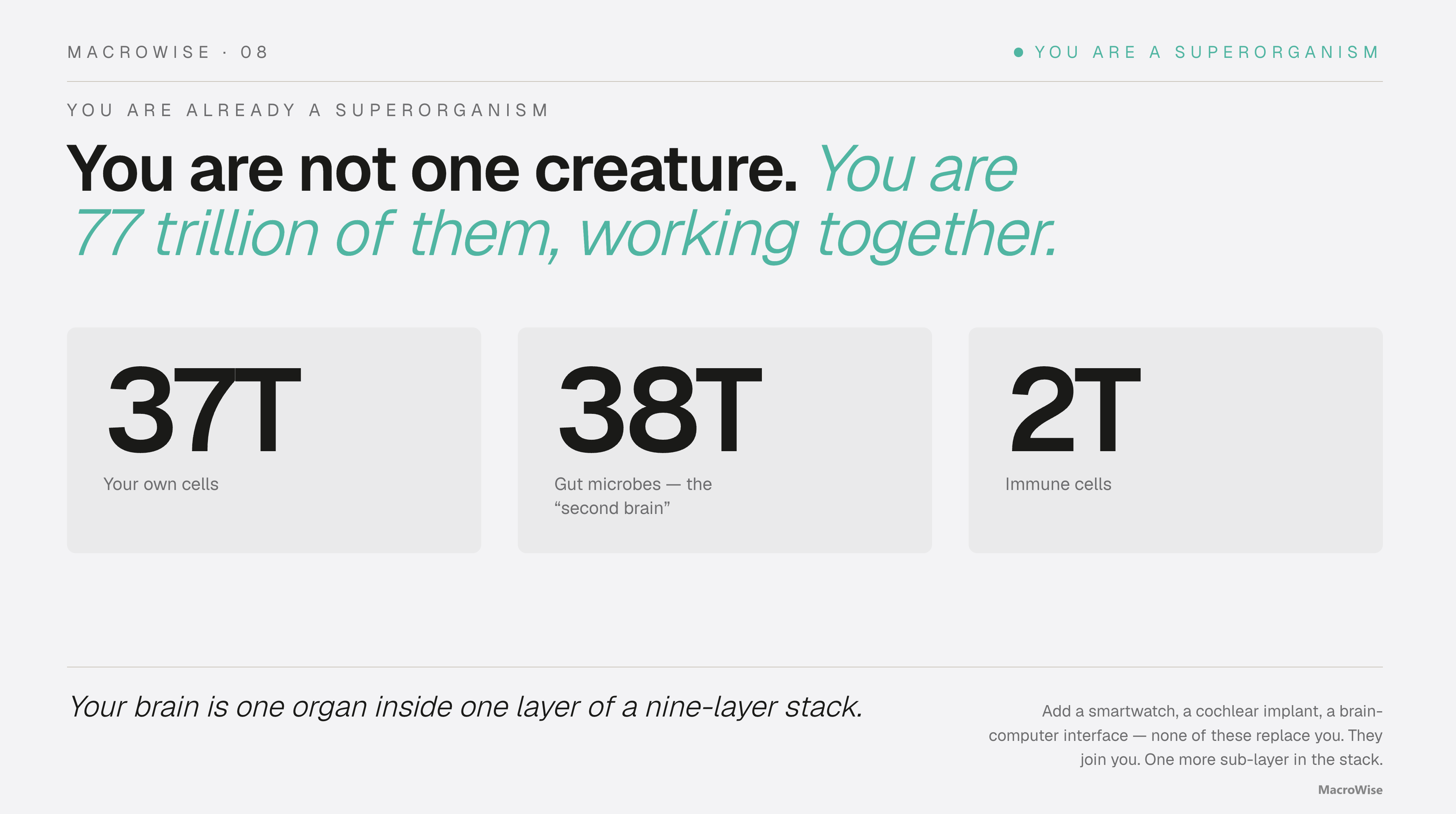
You are a vast network of nine layers, and your brain is one organ inside one layer of it.
Now think about what happens when you add silicon. A smartwatch tracking your heart. An implant helping you hear. A small chip letting you type with your mind. None of these are replacing you. They’re joining you. Adding a new sub-layer to the stack.
The future isn’t a bigger silicon brain replacing humans. It’s humans, machines, and AI working as one body — one more layer in the stack.
What this means for your money
Once you see the stack, the investing thesis writes itself. The right bet isn’t which substrate wins. The right bet is: invest in whatever adds more layers to the human stack. Avoid whatever tries to replace existing layers.
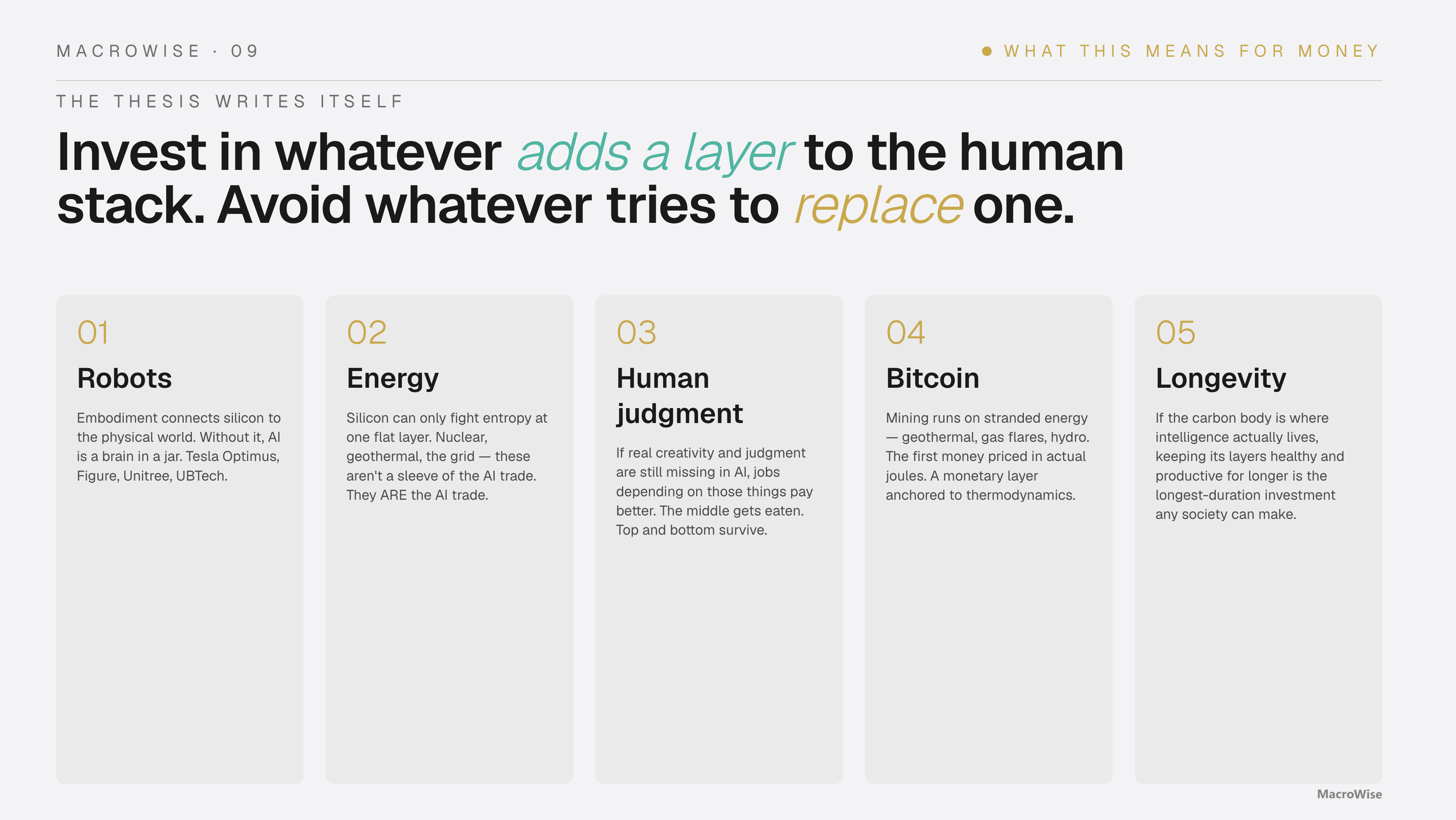
1. Robots add a layer. They connect silicon to the physical world. Without that connection, AI is a brain in a jar. Tesla Optimus, Figure, Unitree, UBTech. Embodiment is the bet.
2. Energy is the real bottleneck. Silicon can only fight entropy at one flat layer. Nuclear, geothermal, the grid — these aren’t a sleeve of the AI trade. They are the AI trade.
3. Human judgment becomes more valuable. If a carbon brain is the only thinker that can coordinate nine layers — and the AGI builders themselves admit real creativity and judgment are still missing — then jobs depending on those things pay better. The middle gets eaten. Top and bottom survive.
4. Bitcoin is the money that fits. Mining runs on stranded energy — geothermal in El Salvador, gas flares in Texas, hydro in Bhutan. It’s the first money priced in physical work — actual joules. It adds a layer to the stack: a monetary network anchored to thermodynamic reality.
5. Longevity is now an investment category. If the carbon body is where intelligence actually lives — if the stack itself is the substrate — then keeping those layers healthy and productive for longer is the longest-duration investment any society can make.
What I hope this adds
Let me close where I started. Andreessen, Hassabis, and Thiel are each doing their best thinking about the most important question of our era. I think each of them is partly right in ways that, combined with the thermodynamic layer underneath, produce a richer picture than any of them has named alone.
Andreessen is right that the scale is historic and underestimated. Hassabis is right that today’s systems are missing capabilities that matter, and that the human brain remains the only existence proof of general intelligence. Thiel is right that Silicon Valley’s assumptions about what intelligence is are doing unaudited metaphysical work.
What I want to add is just this: intelligence appears to be what nine layers of fractal network look like from the inside, fighting entropy across nine dimensions of organization, when the top layer becomes complex enough to model itself. Silicon operates on four flat layers. That gap is not engineering. It is dimensional. And dimensional gaps don’t close by adding more chips.
For AI research: the most promising directions may be the ones that add network layers to the existing carbon stack — brain-computer interfaces, embodied robotics, biological computing, hybrid systems — rather than the ones that try to recreate the whole thing from scratch. Hassabis’s “missing ideas” may turn out to be missing layers.
For investment: the next decade’s alpha may be concentrated in whatever extends the carbon-silicon hybrid, not in whatever tries to replace it. That’s a positioning shift with real money on it. It’s the kind of shift that happens slowly until it happens all at once.
I offer this with respect. I admire the people I’ve named. We’re all trying to figure out the same thing, and the conversation gets better when more layers are on the table.
The universe doesn’t reward size. It rewards dimensional depth. Life is what dimensional depth feels like when it becomes complex enough to model itself. Intelligence is what life feels like when it becomes complex enough to model the universe back.
Carbon does all three. Silicon, on its own, does none. Together they could do something new. That’s the bet I’m making. That’s the conversation I hope we can have.
Kind regards,
Risk isn't volatility. It's the atrophy of learning. And atrophy is measured in the speed of recovery
Guillermo Valencia A
Cofounder of MacroWise
Muy bueno!
Brillante su ponencia, mil gracias