
Originality is the last scarcity
AI made average thinking free. It feels like intelligence. It’s the biggest force for sameness ever built.
In 1997, the best chess player alive lost his job to a machine.
Garry Kasparov was about as good at chess as a human can get. And a computer that was worse than him at almost everything, except crunching numbers, beat him anyway.
Most people took the easy lesson: the machines are coming for us.
They missed the real one. To get it, you need to know how a mind actually grows. It happens at four levels, and you climb from the bottom up:
Level 1 — Imitation. You copy. The oldest one. It’s how you learned to talk. Level 2 — Optimization. You get better at the game inside the rules that already exist. Level 3 — Cross-pollination. You take what works in one field and use it somewhere it’s never been tried. Level 4 — New paradigm. You stop playing the game better and change the game itself. A whole new way of seeing.
The bottom two levels keep you inside the lines. The top two are how you draw new ones.
Machines are already far better than us at the first two. Kasparov didn’t lose to a smarter mind. He lost to something that had maxed out the bottom two levels and never got tired.
Now look at what other people did with the top two.
Demis Hassabis grew up in that same chess world. A child prodigy. He didn’t try to beat the machines at their own game. He climbed. He mixed chess with brain science, and brain science with computers — that’s level three — and pointed the mix at a problem nobody had solved in fifty years: figuring out the shape of proteins, the tiny machines that run all living things. That’s level four. A whole new approach. In 2024 he won the Nobel Prize. Not in chess. In chemistry.
Elon Musk lives on the top level on purpose. He doesn’t try to make old industries a little better. He rebuilds them from scratch, starting from basic physics. Everyone “knew” rockets were single-use. He made them land and fly again. Everyone “knew” electric cars were glorified golf carts. He made them the car every other company is now chasing. Same move, over and over: ignore the old rules, build up from the ground, create the new thing everyone else copies later.
The machine won the bottom two levels. These people won by leaving them.
Same tool, opposite results. And here’s the part that should worry you:
The machine that beat Kasparov is now in your pocket. And the easy way to use it pulls you right back down to the bottom two levels.
This morning, you reached for the bottom levels without noticing
This morning you asked a machine something you used to ask your own head.
It answered. The answer was good. You moved on.
It felt like nothing. It was one of the most important money moments of your life. Because the most valuable thing in the world just changed, and almost nobody noticed.
We’ve known how this works for over a hundred years. We just never had a machine that could do it at full scale.
In 1890, Gabriel Tarde said people don’t really reason — they copy. We copy each other’s habits, beliefs, and wants, and we do it half asleep, sure the choices are our own. Le Bon added the part that stings: in a crowd, your smarts don’t add to everyone else’s. They subtract. And Ortega named the type — the “mass man” isn’t poor or dumb. He’s anyone who feels like everybody else and feels good about it.
For most of history, thinking like everyone else took effort. You had to be in the crowd, read the same paper, watch the same show.
Now look at your feed.
The posts all sound the same now. Same rhythm. Same dash. Same “it’s not X — it’s Y” twist. Same opener: “Let’s be honest.” A thousand different people, one voice.
That’s not an accident. That’s eight billion people opening the same app and asking it what to think.
A crowd can be genius. The machine kills the thing that makes it genius.
A crowd can be smarter than any expert in it. A crowd at a county fair can guess the weight of an ox better than the judges can.
But that only works under three conditions. Everyone has to know something different. Nobody can be copying their neighbor. And there can’t be one source everyone leans on.
The reason is simple. A crowd is smart when its mistakes are independent, because independent mistakes cancel each other out. What’s left in the middle is the truth.
The moment everyone copies the same source, the mistakes stop canceling.
They pile up.
In 1945, Hayek explained why planned economies fail. What a society knows is spread across millions of minds. No single office can ever gather it all. So the planner just picks one answer and hands it to everyone. Tidy, uniform, and unable to discover anything new.
A language model is a planner like that, but for your mind.
It takes the messy, clashing, all-over-the-place output of every one of us, works out the average, and hands that average back to each person as a starting point. Then millions of people land on that same average, write it down, and feed it back in.
It feels like intelligence. It’s the biggest force for sameness ever built.
A crowd whose mistakes pile up isn’t wisdom. It’s an echo chamber with better grammar.
Here’s the part nobody is pricing
When something becomes cheap and everywhere, its price drops to zero.
Thinking — fast, smooth, average, good-enough thinking — just became cheap and everywhere.
So average thinking is now worth almost nothing.
And the second the average is worth nothing, the non-average becomes priceless.
This is the oldest rule in economics. Value lives in what’s rare. Water is free, diamonds aren’t — not because diamonds matter more, but because they’re rare.
For your whole life, thinking was the rare thing. You got paid for it.
That just ended.
The new rare thing — the only rare thing — is the thought the machine couldn’t have come up with.
Originality is the last scarcity. And rare is always where the money is.
Originality was never about the idea
So if everyone gets the same answer, where does anything new even come from?
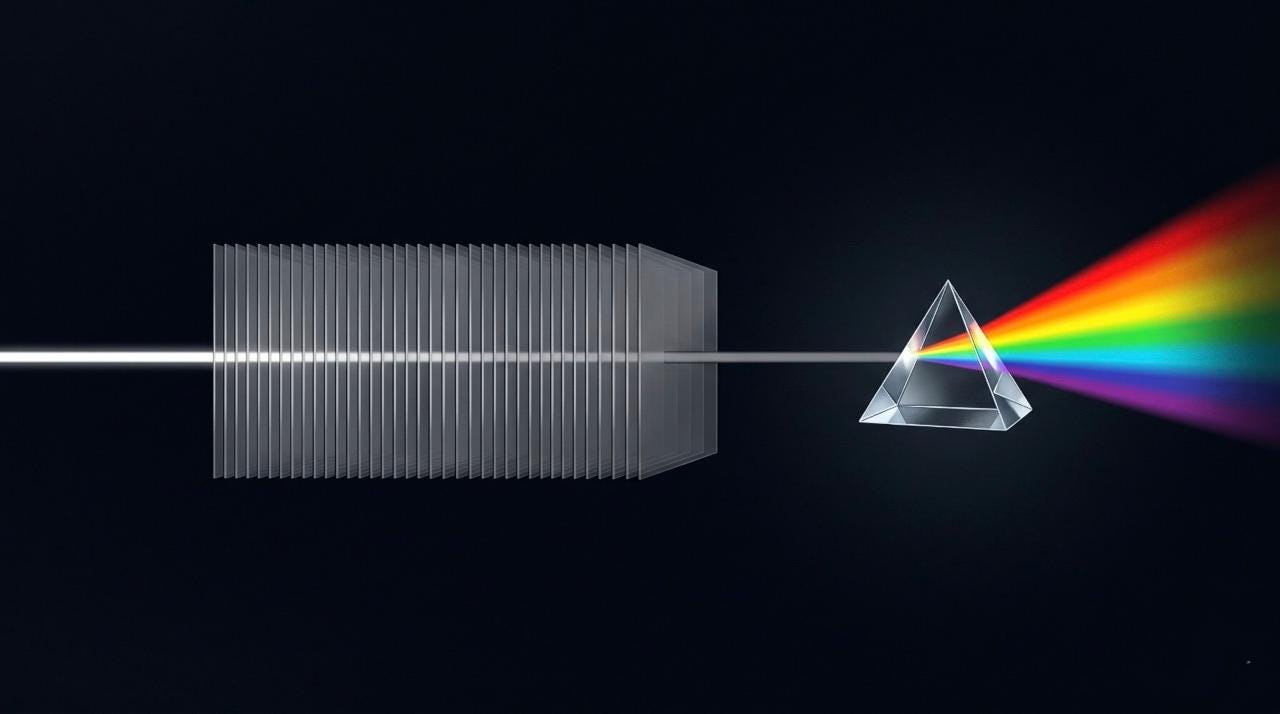
Rick Rubin has the best answer I’ve found. He says you don’t invent ideas — you catch them. You’re an antenna. Ideas are signals in the air, and your job is to stay tuned enough to catch the ones most people miss.
And here’s the line that unlocks it: every person is a prism.
The same world hits all of us. But each of us bends it differently — through our own history, our scars, the odd things we’ve spent years paying attention to.
Originality was never in the signal.
It was always in the prism.
The machine is a prism made from a billion prisms, which is exactly why it’s none of them. It can only hand back the average.
“But it surprises me,” you’ll say. “It connects things I never would. Isn’t that new?”
No. It only remixes what’s already inside it. It blends things people have already written and lands on the spot in between. It never steps off the map.
Real originality — the kind Hassabis used, the kind Musk keeps building — comes from places that aren’t on the map at all. Your body. Your specific life. The failure you’re still ashamed of. The two fields only you happen to live between.
The machine averages what already exists.
You can make what doesn’t.
How to keep your own mind
This isn’t about quitting the machine. Refusing the most powerful tool ever built isn’t smart — it’s ego. Use it. Use it hard. Let it own the bottom two levels so you’re free to climb.
Just don’t let it think for you.
A few rules that actually work:
Write your own answer before you read anything. Make something before you take something in. If you ask the machine first, its answer becomes the anchor and you never get free of it. Get your own rough, half-wrong take down first — then check it. You can only compare against a prism you’ve already built.
Keep a list of the questions it answers badly. That list is the map of your turf — the spots where the average runs out and you begin. Live there.
Treat its answer as the floor, not the ceiling. Whatever it gives you, assume everyone else got the exact same thing. Your work starts where its answer stops.
Keep the friction. Not knowing is uncomfortable, and that discomfort is where new thinking is born. The machine kills it instantly. Sometimes you keep it on purpose.
Argue against it. Make it defend the popular view, then take it apart. Use it as a sparring partner. Never as an oracle.
What’s actually at stake
This was never really about your job.
It’s about whether you end up with a mind of your own at all.
A muscle you stop using doesn’t stay the same. It wastes away. A mind that hands off every hard thought doesn’t stay sharp. It slowly loses the ability to think hard at all. And you won’t notice the day it goes. Sleepwalkers never do.
That’s the real cost, and it builds up quietly. Not that you’ll think like everyone else — but that one day you won’t be able to think any other way.
The machine made average thinking worthless.
Stop reading that as a threat. It’s the best gift anyone has ever handed you. It means the only thing left worth being is the one thing the machine can’t be.
You. Thinking. On purpose.
Nobody is coming to make that choice for you.
You make it every time you open the app.
Thanks for reading,
G
Me gustó bastante,
no podemos bajar la guardia de nuestro propio criterio por más que nos guste y sea útil usar los modelos… son pensamiento muy inteligente pero promedio
En nuestro propio criterio es donde nace la magia y más si se usa lo que tú llamas crospolinizacion y más aún: si logramos pensar como cambiar el juego o crear uno nuevo
Gracias