
Tesla: The Super Learner
Epistemic Wealth — Chapter VI
Everyone was asking the same question. And everyone was wrong.
Is Tesla a good car company?
That was the question. Every analyst, every short seller, every institutional investor spent a decade arguing about the answer.
They were asking the wrong question.
The right question was never about the cars. It was about the learning curve.
The short sellers were right about everything they measured. Negative margins. Missed targets. Broken robots. A CEO sleeping on the factory floor. Every number confirmed their thesis. Every metric supported their position.
They lost everything.
Because the market, over long enough time horizons, doesn’t reward what a company is. It rewards what a company is becoming — and at what speed.
The short sellers analyzed a photograph. The market was pricing a film. The photograph was accurate. The film was worth a trillion dollars.
In our taxonomy: Tesla was the worst car company by every static metric. It was the fastest learning system in the history of the automotive industry. Those two facts coexisted for a decade. The market eventually priced the second one.
This is not a story about Elon Musk’s vision. It’s a story about a pattern. The Dragonfly pattern.
What is a Dragonfly?
In Epistemic Wealth, we’ve identified four archetypes — four patterns of how companies learn from shock:
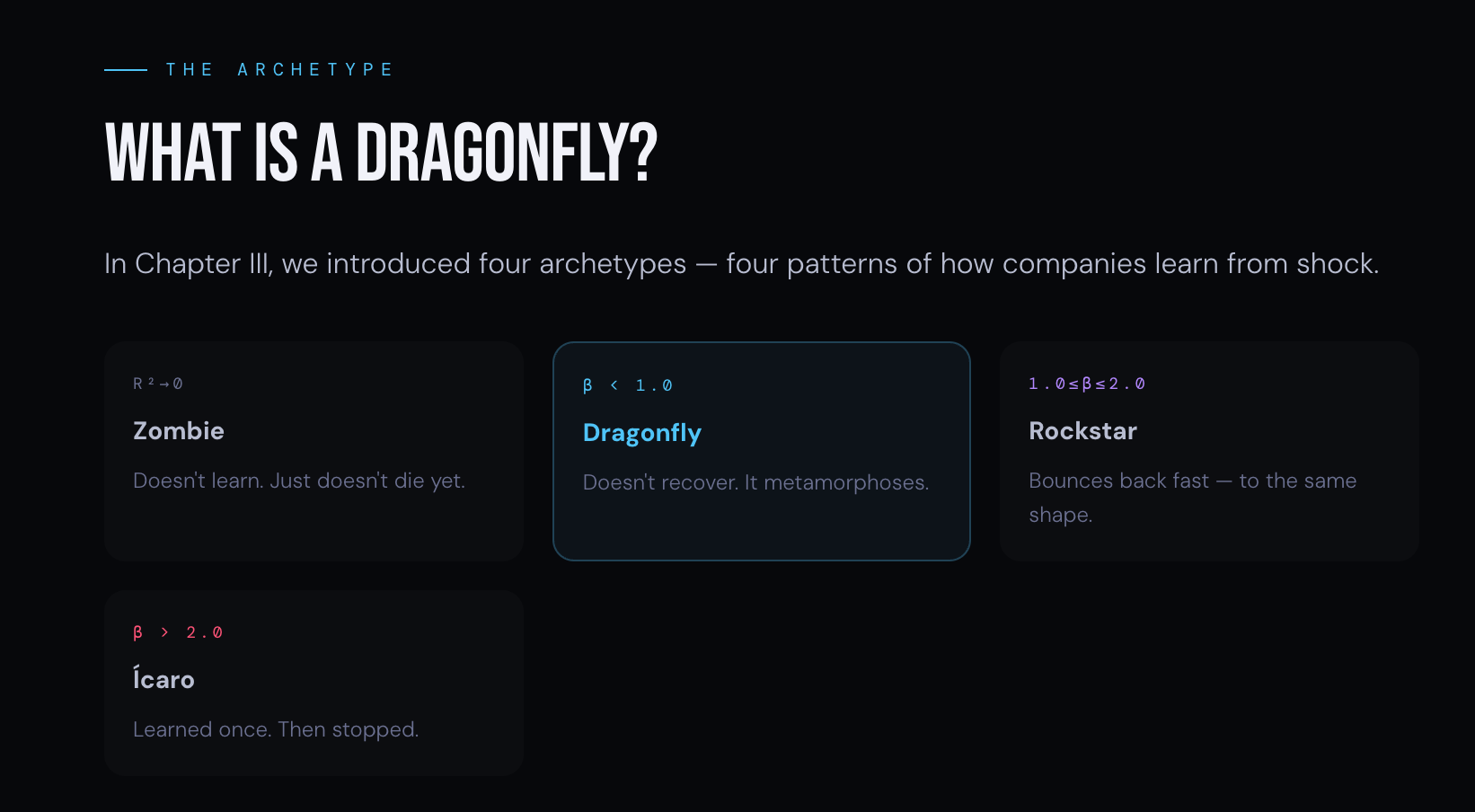
Doesn’t learn. Just doesn’t die yet.
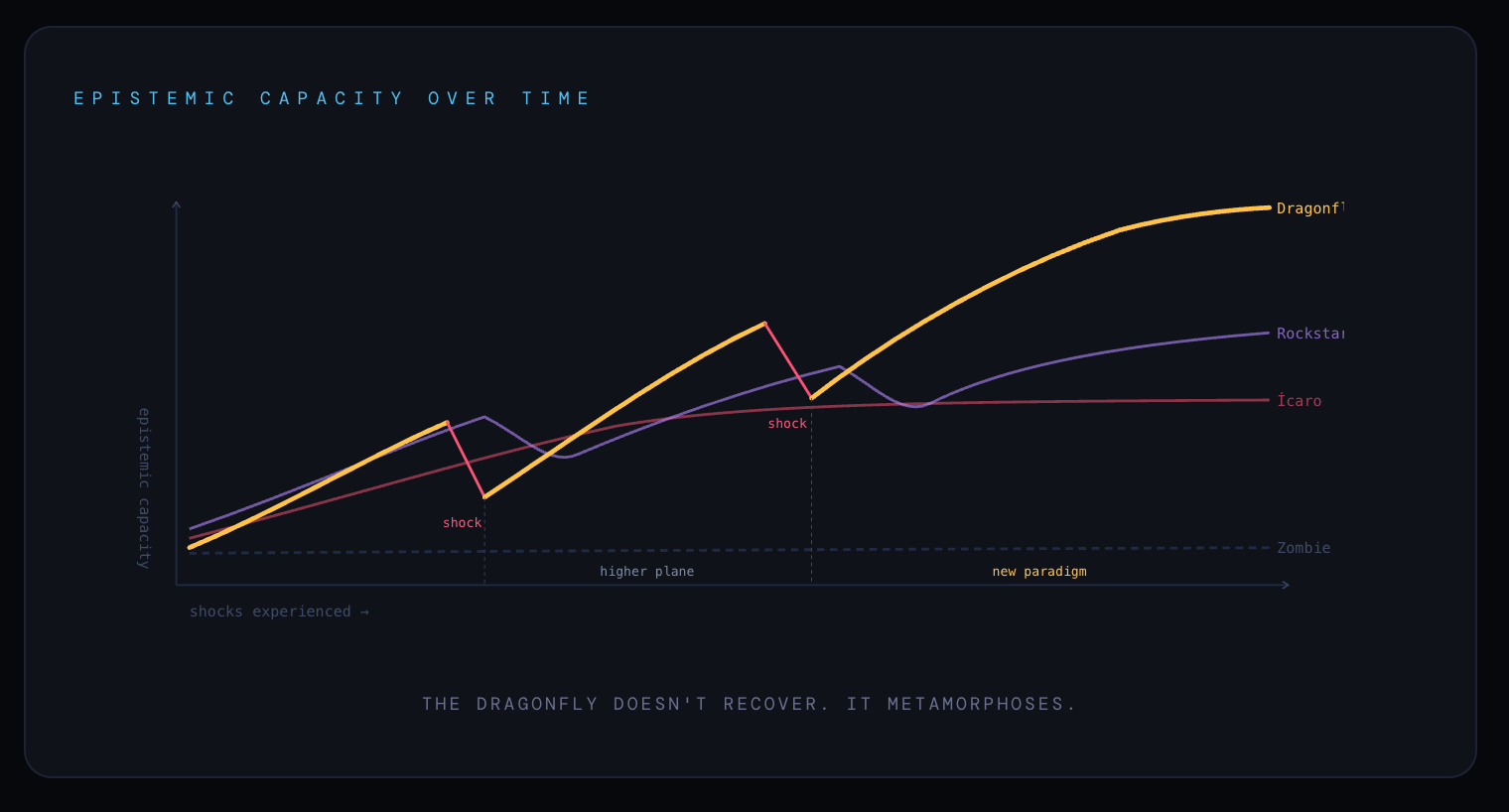
The Rockstar returns to the same shape. The Dragonfly returns to a different one. That difference compounds across every subsequent cycle.
Tesla completed the full cycle — all four modes of learning, in sequence, at speed — with the entire world betting it would fail. Not because it survived. Any Zombie can survive. But because it emerged from each crisis capable of things it literally could not do before.
Four Modes. One Dragonfly.
There are four ways to learn. Most people — and most companies — use one. Maybe two. Tesla used all four. In sequence. In the right order. At an accelerating pace.
Mode 01 — Imitate (2006–2012 · The Roadster Era)
The Roadster was a Lotus Elise with a laptop battery. That’s it. No original chassis. No proprietary cell chemistry. Borrowed technology, borrowed form, borrowed suppliers from AC Propulsion’s tzero prototype.
This was not failure. This was the right first move.
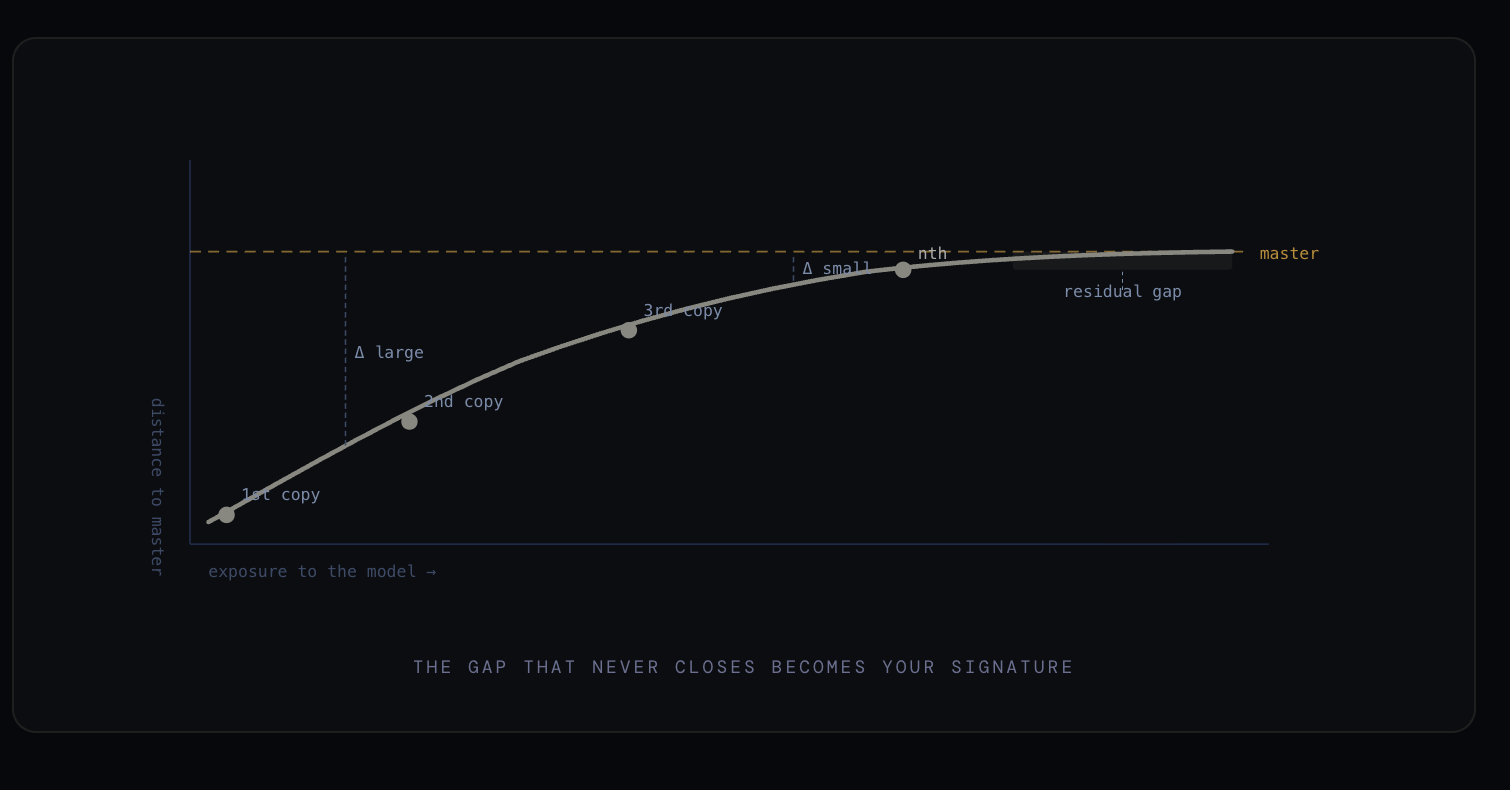
The geometry of imitation is not about rising toward mastery. It’s about converging toward it — asymptotically. Each iteration closes the gap. The gap never reaches zero. And what remains — the residual gap — becomes the fingerprint of your own voice.
Every thermal runaway in the Roadster’s battery pack was a precise measurement of the gap between what Tesla understood and what needed to be true.
Mode 02 — Optimize (2013–2017 · Gigafactory Nevada)
Once Tesla knew what a battery needed to be, it built a system to produce it at falling cost per iteration.
Battery cost: $1,000/kWh in 2010. Under $100 by 2023.
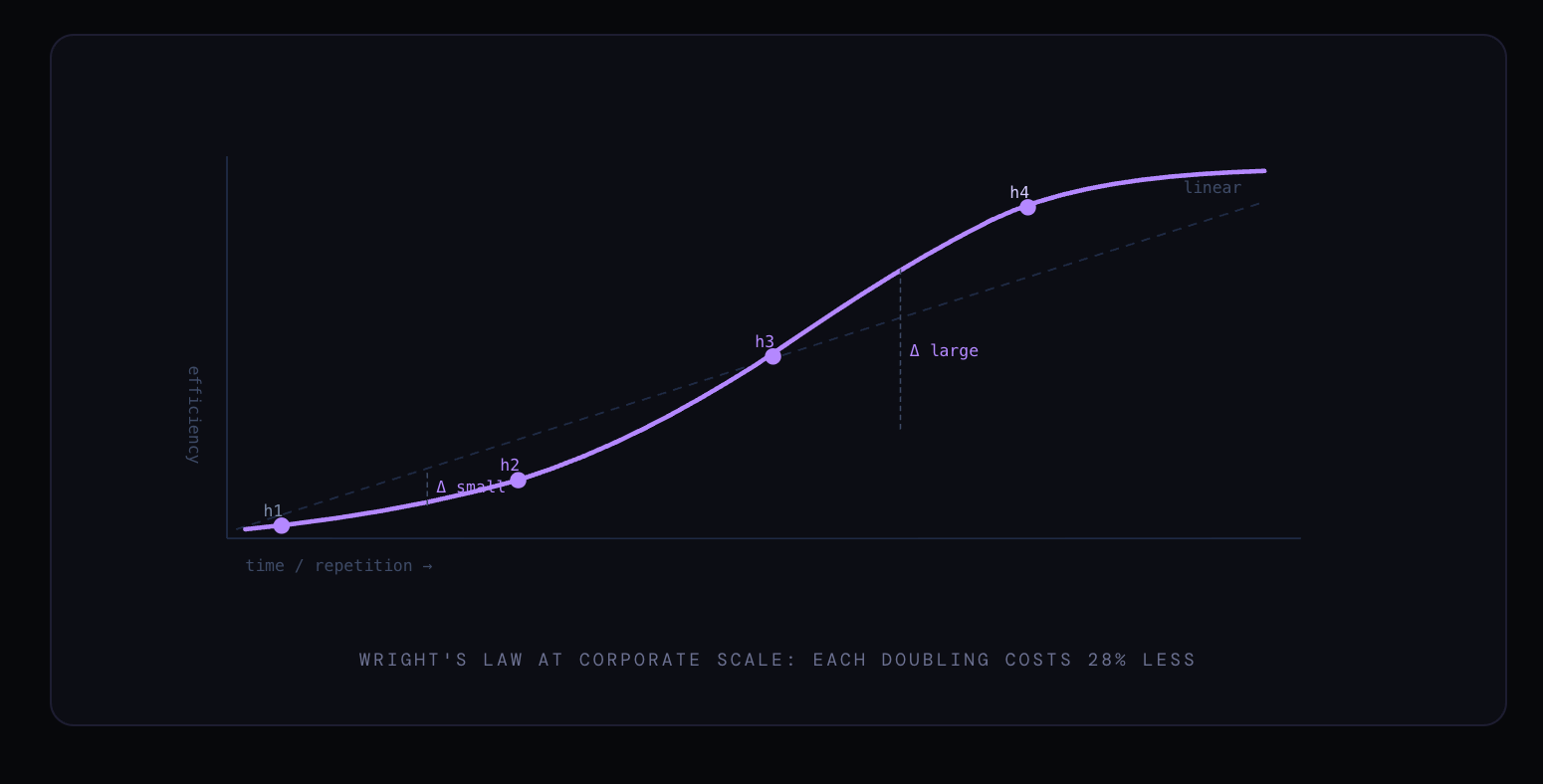
That’s not efficiency. That’s compounding. Each production cycle fed data back into the next. Each doubling of output generated a 28% cost reduction — Wright’s Law operating at corporate scale.
The Gigafactory was the institutionalization of the second mode. Not just making cars faster. Building a machine that makes the machine better with each cycle.
The short sellers saw the losses. They missed the curve accelerating beneath them.
Mode 03 — Cross-Pollinate (2016–2021 · Autopilot · 4680 Cell · Energy Division)
Software OTA updates — from consumer tech — applied to physical vehicles. Aerospace thermal management applied to battery packs. Video game rendering engines repurposed for autonomous driving simulation.
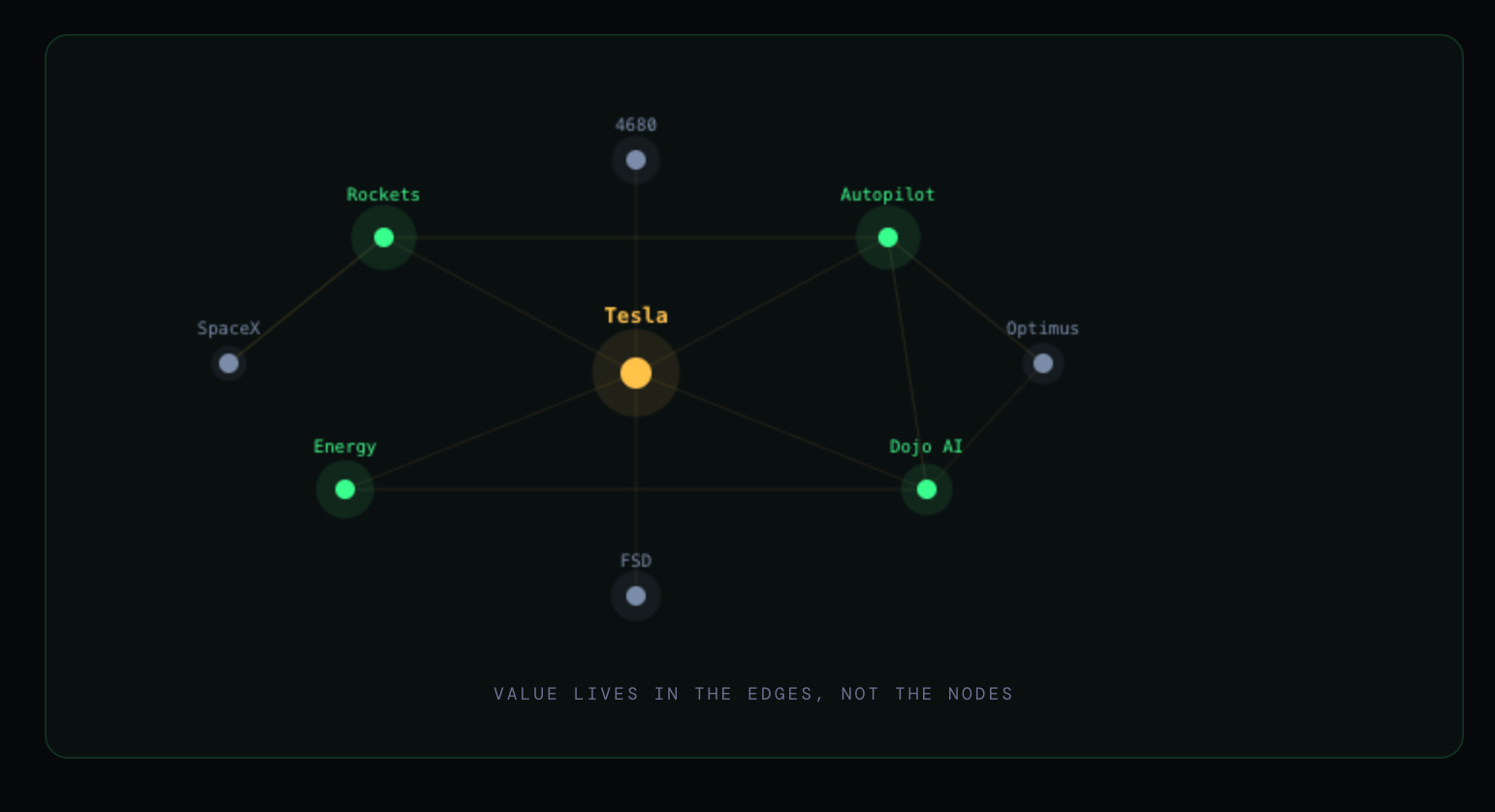
SpaceX’s “make the part disappear” manufacturing philosophy applied to the structural battery pack, eliminating 370 components.
None of these connections existed inside the automotive industry. The value didn’t come from any single field. It came from the borders between them.
This is the network effect of knowledge. Not n nodes — n² connections. The insight lives in the edge, not the node.
Mode 04 — New Representation (2021–Present · Dojo · Optimus · Energy · Mars)
A car is not a vehicle.
That is the new representation Tesla invented. A car is a data collection node in a global fleet intelligence network. Every Tesla on the road feeds real-world edge cases back into Autopilot’s training corpus. The value of each individual car is inseparable from the value of every other car ever sold.
The product and the training data are the same thing. The customer and the researcher are the same person. The revenue model and the learning engine are the same machine.
But the new representation doesn’t stop at the car. Fleet data doesn’t just train autonomous driving — it trains Dojo, Tesla’s AI supercomputer. Dojo trains Optimus, the humanoid robot. And Optimus will build the factories no one else can build. Including the ones on Mars.
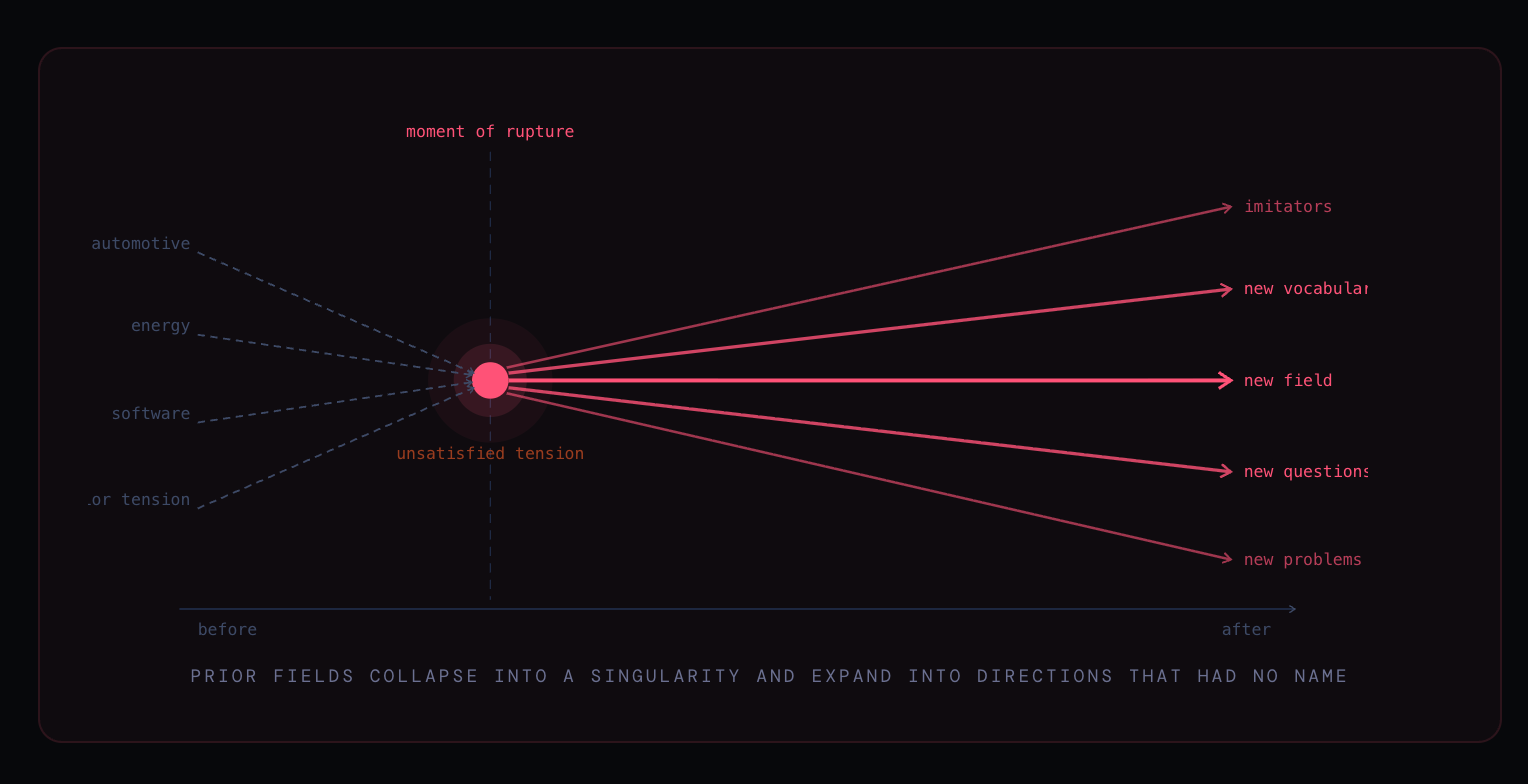
This is not innovation. Innovation happens inside an existing field. This is a new field — multiple fields simultaneously. And the proof that you’ve created a new field is always the same: others begin imitating your language. The cycle restarts — from another plane.
KERNEL
Costco perfects a heuristic (Mode 02). Apple connects worlds (Mode 03). Tesla used all four modes in sequence — imitate, optimize, cross-pollinate, represent — and each one compounded on the previous. That’s why Tesla isn’t a Rockstar with Dragonfly DNA like Apple. Tesla is the complete Dragonfly. The Super Learner.
Every loss was a purchase.
2018. Tesla is burning $8,000 per minute. The Model 3 is being assembled by hand in a tent. The CEO is on a podcast, smoking marijuana.
Short interest hits an all-time record. Every rational analyst points in the same direction.
They were right about everything. They were wrong about the only thing that mattered.
The tent was not chaos. It was the most expensive classroom Tesla ever built.
In that tent, Tesla learned — in real time, under production pressure, with the company’s survival at stake — exactly how automated assembly lines fail. The specific failure modes of its welding robots. The precise thermal limits of its battery modules. The organizational structures that collapse under scale and the ones that hold.
That wasn’t a $900 million loss. It was a $900 million purchase of manufacturing knowledge that no textbook could have taught.
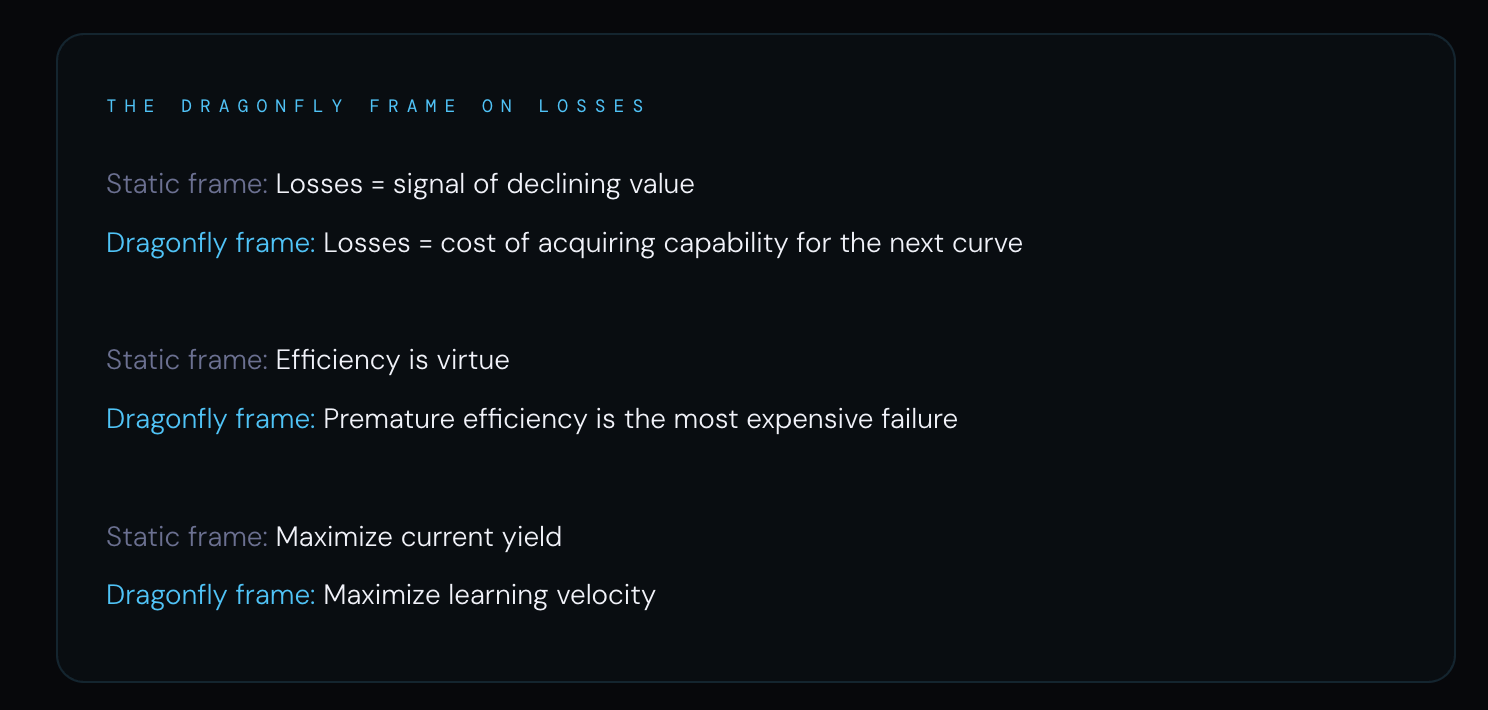
The Dragonfly frame on losses:
What the numbers say
We measure epistemic learning speed using a metric we call β — how fast a company recovers, and how it recovers, from market shocks.
Costco: β = 1.54. Apple: β = 1.38. Both Rockstars — they bounce back fast, to roughly the same shape.
Tesla’s signature is different. 16 epistemic cycles from 2010 to 2026. β = 1.86. R² = 0.51.
A high β with a low R² is the Dragonfly fingerprint. It’s not a predictable recovery. It’s chaotic transformation — each crisis producing a structurally different company on the other side.
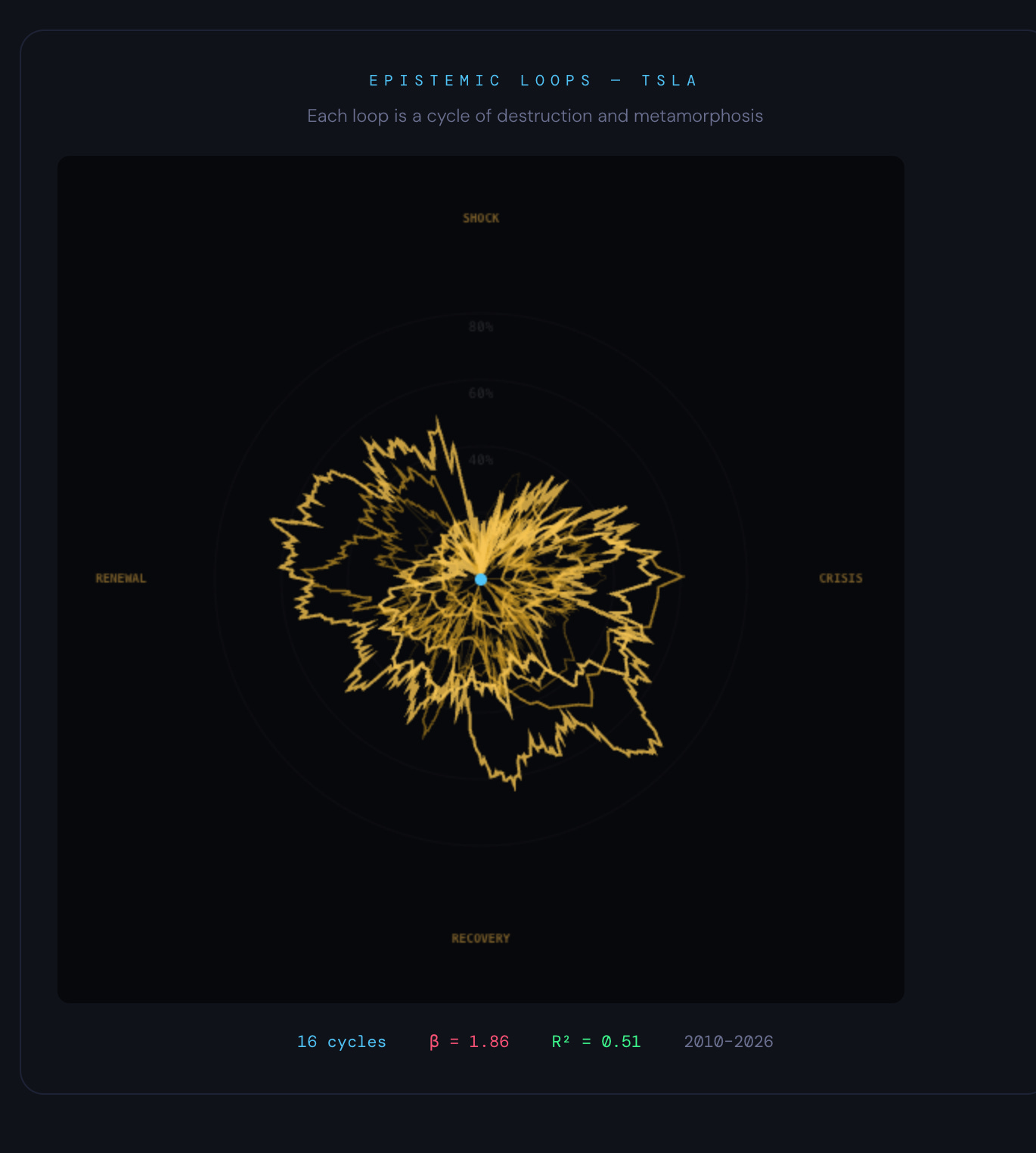
The R² of 0.51 tells you something important: half of Tesla’s recovery pattern is unexplained by the historical model. That’s not noise. That’s the part where the metamorphosis happens.
The Elon Ecosystem
Here is the cascade that most investors miss:
Fleet data → Dojo → Optimus → SpaceX → Mars
Every Tesla on the road generates visual data — edge cases, weather conditions, failure modes, human driving patterns. That data trains Dojo, Tesla’s AI supercomputer built at 1.8 exaFLOPS of training capacity. Dojo trains Optimus — the humanoid robot projected to cost ~$20,000 per unit, targeting a global labor market of 3 billion workers.
The same neural nets that guide a Tesla through a street will guide Optimus through a factory. Tesla didn’t build robots from scratch — it leveraged five years of fleet-scale visual inference.
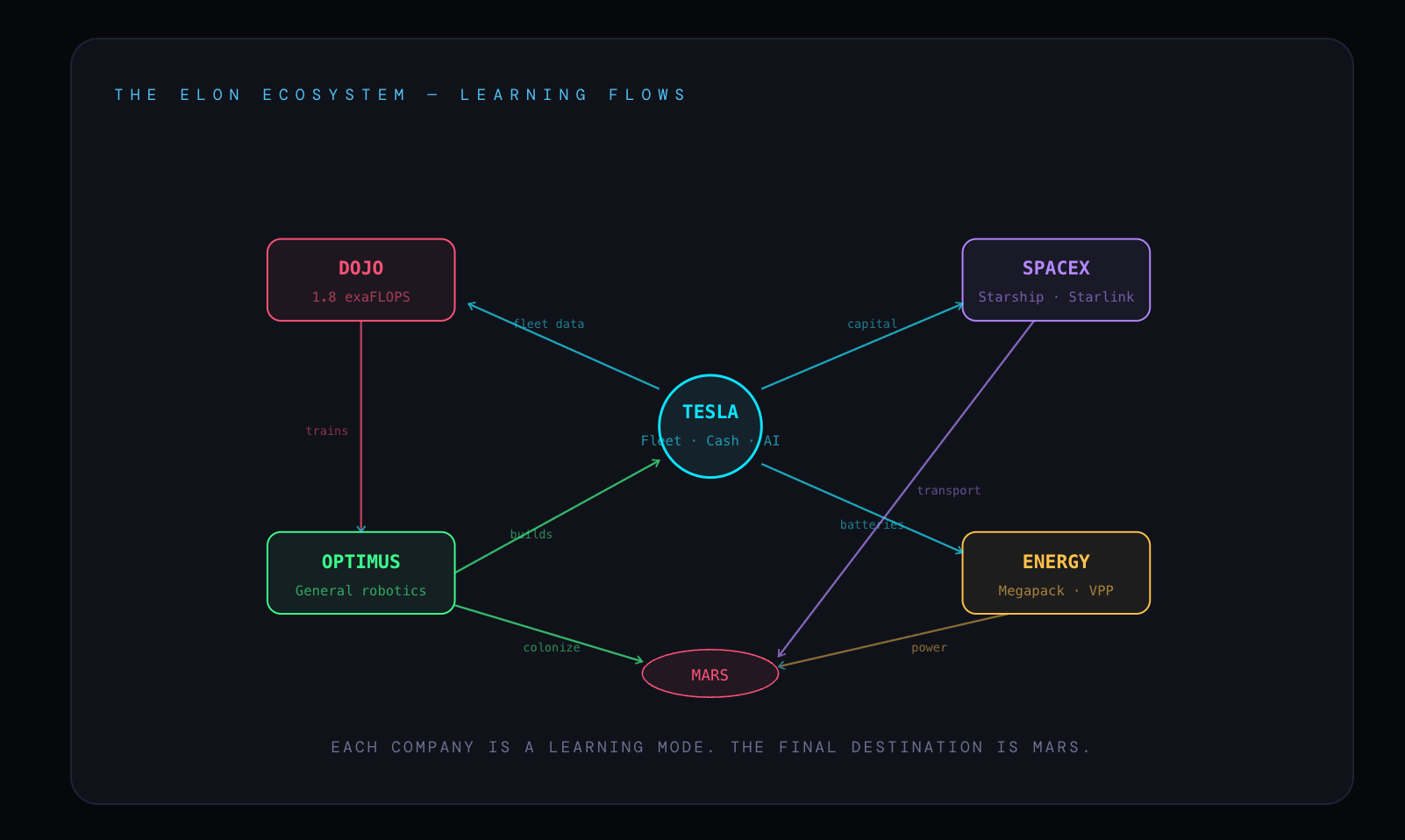
Tesla Energy (Megapack, Powerwall, Virtual Power Plants) generates the capital. SpaceX builds the transport — Starlink already generates $10B/year, funding Starship, designed to carry 100 people to Mars per trip. SpaceX used the identical Dragonfly pattern: imitated NASA, optimized launch cost from $65,000 to $1,500 per kg, cross-pollinated aerospace manufacturing, and invented the new representation of the reusable rocket.
The car was the excuse. Dojo is the brain. Optimus is the hands. SpaceX is the vessel. Energy is the fuel. Mars is the destination.
KERNEL
The β metric we apply to Tesla measures a company’s financial learning speed. But the real β Musk is engineering is different: the learning speed of a civilization. How many shocks humanity can absorb and emerge with greater epistemic capacity. Tesla is the engine financing that curve. SpaceX is the direction it points. Optimus and Dojo are the how.
The Dragonfly Hierarchy
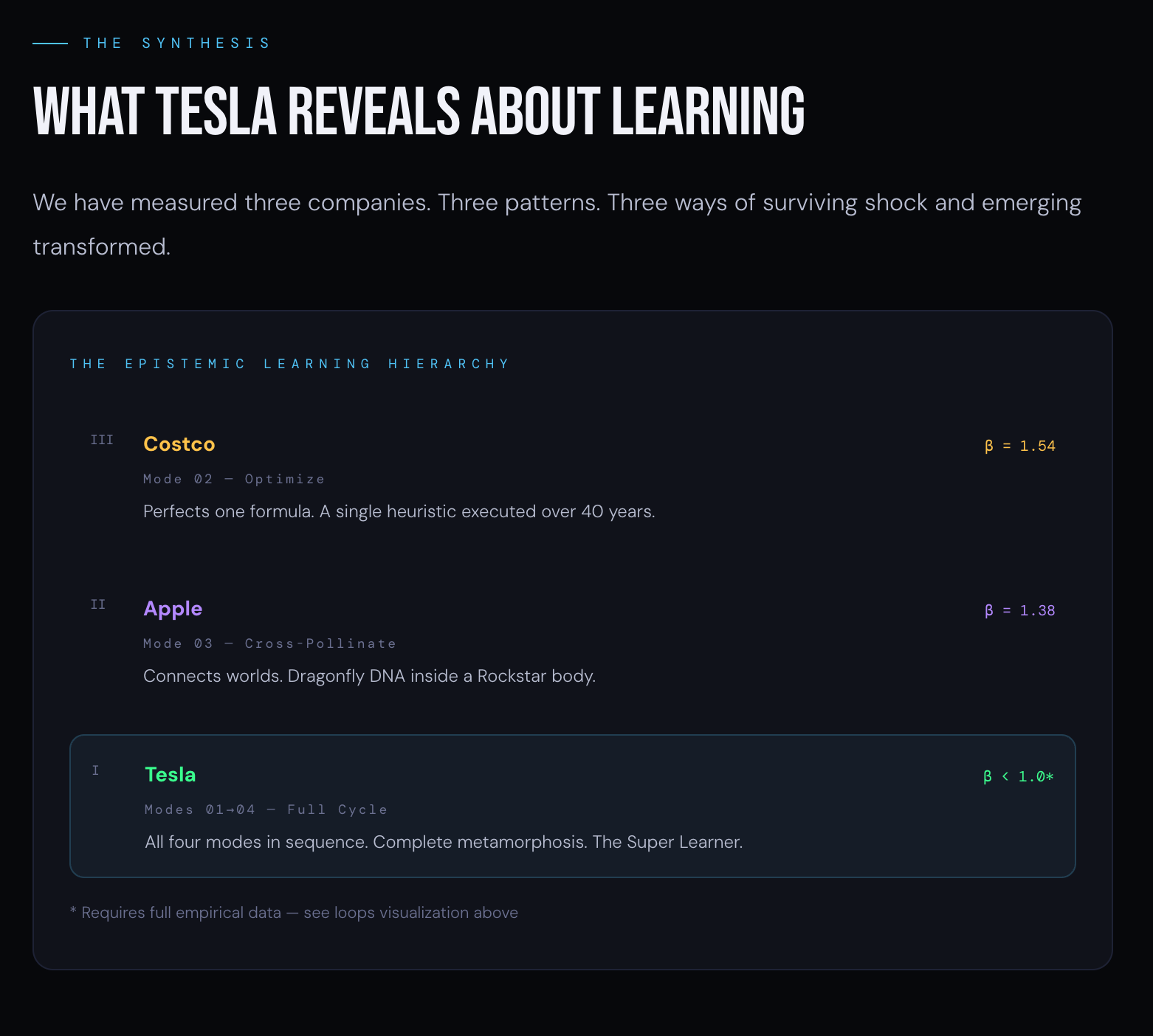
Costco perfects one formula over 40 years. Apple carries Dragonfly DNA inside a Rockstar body — it dies, is reborn, and redesigns the future. Tesla is the complete Dragonfly: each mode compounding on the previous, each crisis producing a metamorphosis, the β of the system accelerating with every loop.
The final question
“The probability of something catastrophic happening is high. I’m not trying to be anyone’s savior. I’m just trying to think about the future and not be sad.” — Elon Musk, 2018
What does it mean to be a civilization-level Dragonfly?
Most companies measure success in return on equity. A few measure it in market share. Tesla — or more precisely, the system Tesla is part of — measures it in something else: the capacity of our species to survive the next shock.
That is the civilizational β.
The question isn’t whether you believe in electric cars. It’s whether you understand what the learning curve actually is.
Thanks for reading,
Guillermo
Epistemic Wealth is a chapter-by-chapter manifesto on how human-machine intelligence is rewiring global markets. Written by Guillermo Valencia A.
Read the full interactive chapter bilingual text — at epistemic.macrowise.capital/chapter-6
No puedes hacer cosas diferentes con lo mismo, tienes que buscar a personas que piensen desde primeros principios. Qué cuestionen hasta el más mínimo estándar. El análisis es directo, profundo y brillante. De verdad muchas gracias Guillermo.
Tremendo !!!
Intentar algo imposible, romperse en el camino, descubrir lo que otros no habían visto y repetir el mismo ciclo tantas veces como sea posible.