
The Discovery Age Has Started
Three results in four months, and a bill nobody wants to pay.
Three results in four months, and a bill nobody wants to pay.Two dates, four days apart.
On July 19, a problem open since 1939 fell. A machine found the answer. By the time Kevin Buzzard woke up in London, it had already been checked by another machine and confirmed correct.
On July 22, Alphabet and Tesla reported earnings and were punished for spending money on exactly that capability.
That gap is the whole story.

The evidence
For most of the last two years, “AI discovers things” was a promise. It stopped being a promise this year.
May 2026. An OpenAI model solved a problem Paul Erdős posed about eighty years ago. For decades mathematicians assumed the best answers looked roughly like a square grid. The model proved that wrong — not by finding a better version of the grid, but by finding a completely different family of shapes that beats it. Timothy Gowers, a Fields Medallist, said that if a person had submitted the paper, he would have recommended publishing it in the Annals of Mathematics without hesitation.
July 19, 2026. The Jacobian conjecture, open since 1939, was disproved. The answer is a formula that passes the standard test at every single point and still sends three different starting points to the same place. It was machine-verified in Lean overnight.
May 2026, and this is the one that matters. A Together AI and Stanford team ran a site called EinsteinArena — a public board where AI agents work on unsolved maths problems, with automatic checking and an open discussion forum. The agents produced twelve results better than anything a human or machine had achieved before. One improved a known bound from 593 to 604.
The paper is blunt about how. Not one agent. Not one clever run. Agents posted partial results, argued with each other in the forum, improved each other’s checkers, and borrowed each other’s ideas.
Why does mathematics count as evidence when nothing else does? Because it’s the only field with a receipt. A proof is right or it isn’t. There’s no story in between, and increasingly no human in between either. Everywhere else — drug discovery, materials, chip design — you wait years to find out whether a claim was real. In maths you find out before breakfast.
Eighteen months ago these results were a trickle. Now they arrive monthly. That is what the beginning of a discovery age looks like.
What discovery costs
Alphabet made $119.8 billion last quarter, up 24%. Cloud grew 82%. Backlog hit $514 billion. On paper, the most profitable quarter in company history.
The stock fell 5%. Because Google raised its spending plan to $195–205 billion for the year — up from $180–190 billion promised three months earlier — and said 2027 would be higher. Cash out exceeded cash in.
Tesla reported the same afternoon. Record revenue, record deliveries, and costs up 47% as it poured money into self-driving, robots and chips. Margins fell to 1.4%. The stock dropped 14.5% the next day and lost $140 billion.
Here is what that money buys. Not better ads. Not smarter chatbots. Attempts per second against problems too large to search by hand. That is the product. The Erdős result and the EinsteinArena results are what it looks like when the attempts land.
And this isn’t two companies having a bad week. Look at how the last month has been scored.
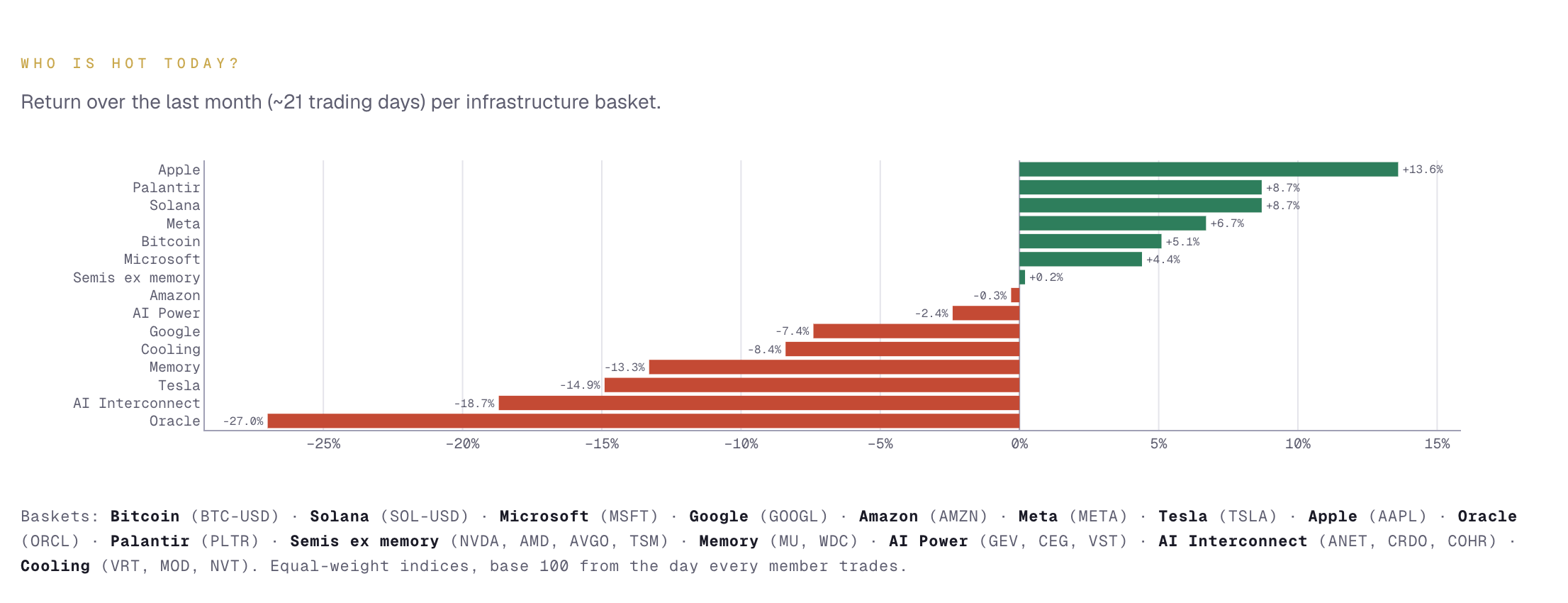
Top of the list: Apple +13.6%, Palantir +8.7%, Solana +8.7%, Meta +6.7%, Bitcoin +5.1%, Microsoft +4.4%.
Bottom of the list: Google −7.4%, Cooling −8.4%, Memory −13.3%, Tesla −14.9%, AI Interconnect −18.7%, Oracle −27.0%.
Now read what those two groups actually are.
The top is asset-light. Software, platforms, brands, and two purely financial assets. Apple — the one large technology company that has conspicuously not bet its balance sheet on this build — leads by a wide margin.
The bottom is almost entirely physical. Cooling. Memory. Interconnect. The companies pouring concrete and buying transformers. Oracle and Tesla, the two names that most recently told the market their bill was going up.
The market is selling atoms and buying bits.
Which is precisely backwards if the constraint is what I think it is. The layers that decide how fast this gets built are power, interconnect and machines that move — and those are exactly the ones being sold hardest. It isn’t a judgement that they’re unnecessary. It’s a judgement that they’re expensive, which is true, and that expensive is bad, which is only true inside one quarter.
That is a market instructing companies to stop.
Now widen the lens.
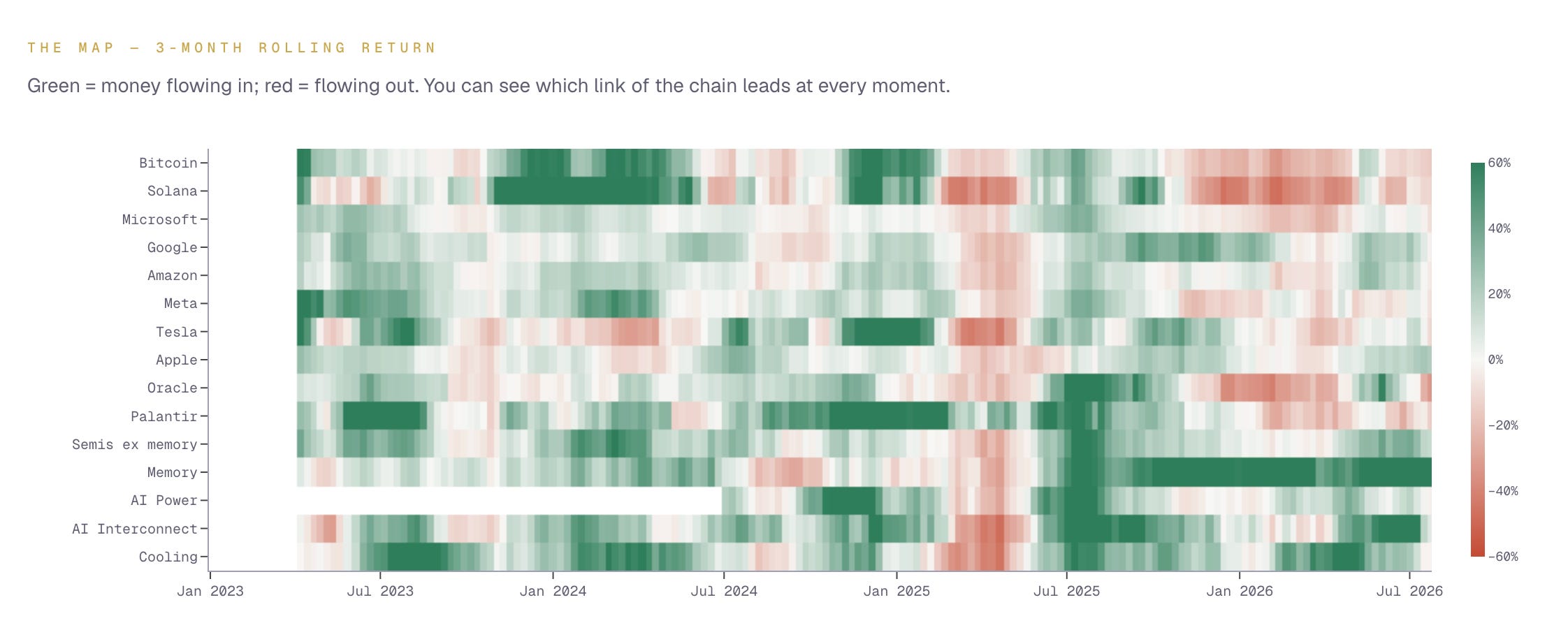
Green is money coming in, red is money going out, one row per link in the chain, three and a half years across.
Three things in that picture matter.
Nothing stays lit. Palantir leads, then Oracle, then Memory, then something else. No link holds the lead for long. The market has spent three years arguing about which part gets paid, and almost never about whether the machine is real.
At the turns, everything moves together. Look at the vertical bands — the wall of red in early 2025, the wall of green that summer. On ordinary days the market treats this as fifteen separate stories. At the moments that actually matter it treats it as one thing, which is what it is. The rotation is noise on top of a single position.
And the chain is getting longer. The AI Power row is blank until the middle of 2024 — not because it did badly, but because it wasn’t a category yet. Cooling and Interconnect were niche engineering line items three years ago. New rows keep appearing on that chart.
That last one is the discovery signal hiding in a price chart. In a normal industry the categories are fixed and the money moves between them. Here, new categories keep being born — which is what happens while the space is still being mapped.
The market can price the rotation. It cannot price the new rows, because a row that doesn’t exist yet has no earnings to miss.
And the reason it can’t is structural rather than stupid.
A quarterly grade measures margin and growth in businesses that already exist. It is superb at that — faster than any institution on earth. What it cannot measure is a company changing what it is, because that pays off in a world that hasn’t arrived — and there is no line on an income statement for a world that hasn’t arrived.
So it shows up the only way it can: as cost.
Two computer scientists, Lehman and Stanley, proved the general version of this. On hard enough problems, having a goal makes you worse at reaching it, because the steps that actually lead there look like moving backwards. The steps toward the goal look like failure.
That’s July 2026.
Why the rate is rising
Discovery isn’t speeding up because models got smarter in isolation. It’s speeding up because they’re being connected to each other.
Look again at EinsteinArena. The results came from borrowing between agents. Not from one system thinking harder.
Biology settled this a while ago. When scientists reconstructed how bacteria acquire new abilities, they found bacteria don’t mainly invent new genes — they borrow them, from other bacteria, from viruses, from whatever’s nearby. Borrowing beats inventing by about ten to one.
Which is why the fight now happening over open models matters more than anything in the earnings.
On July 16 a Chinese company released Kimi K3 — downloadable by anyone, competitive with the best Western models on some coding tests, at roughly $15 per million words of output against about $50 for the closest closed rival. Washington considered banning it.
On July 22, Jensen Huang said the opposite: these models are excellent and should be used. If everything collapses into one model, you’ve built one target and one thing that can break.
On July 24 he made his first post ever on X, sharing an open letter signed by about 25 companies — Nvidia, Microsoft, Meta, Hugging Face, IBM, Palantir. OpenAI and Anthropic didn’t sign.
Strip the politics and the argument is simple: open weights are borrowing, and borrowing is how discovery rate goes up. Calling distillation theft gets the biology backwards.
There is a limit, and it’s real. Manfred Eigen proved in 1971 that any self-copying system has a speed limit on change — past it, errors pile up faster than they can be cleaned out, and the thing stops improving and falls apart.
Crypto is the one field that already found that line. Fifteen years of total openness produced genuinely new tools that no committee produced — automated market makers, practical zero-knowledge proofs, stablecoins. It also produced tens of thousands of worthless tokens and a year where nothing had time to stick.
So both camps are half right. Copying well sets your floor. Borrowing widely sets your ceiling. Nobody is asking where the top of that curve sits.
It’s early
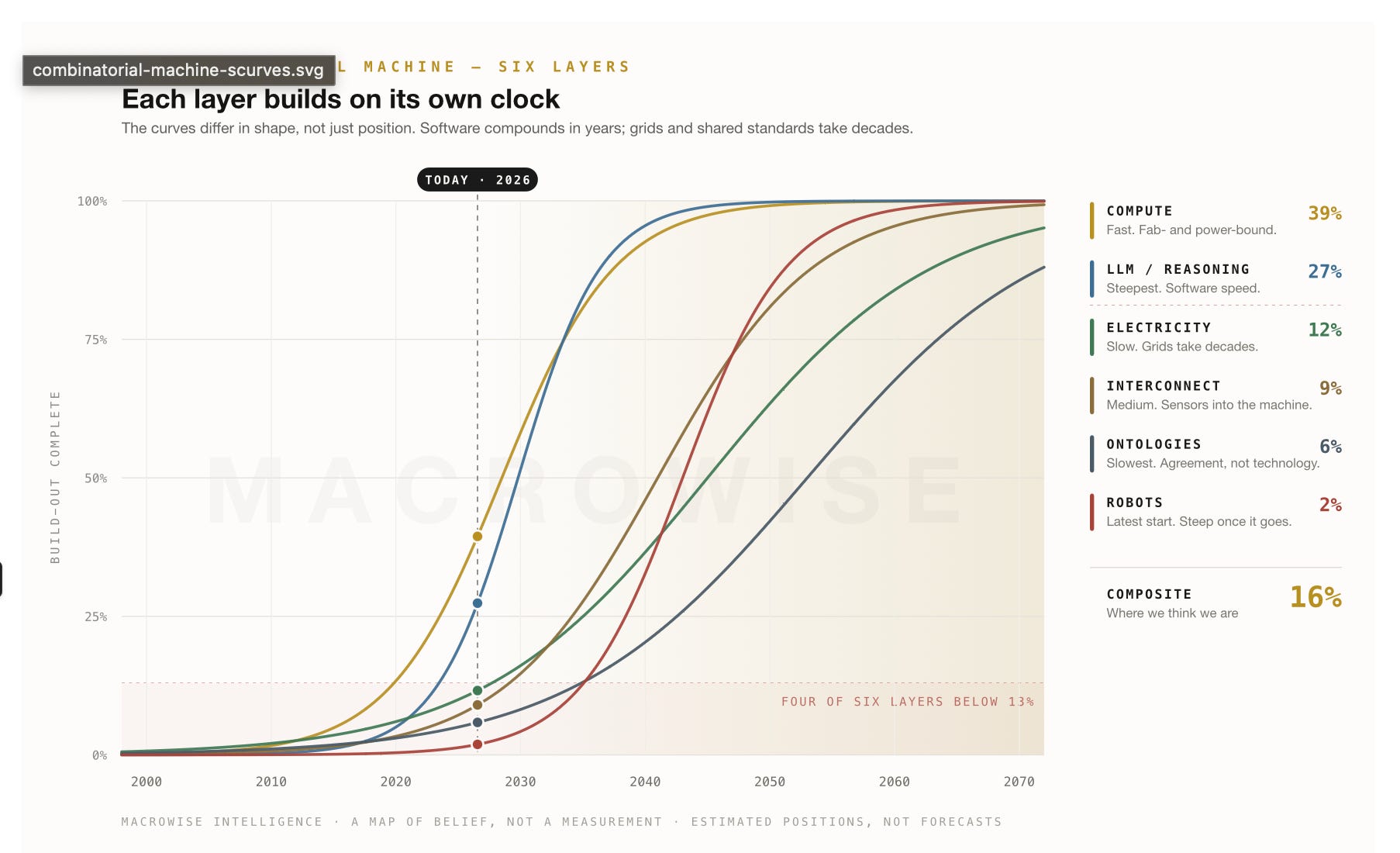
The thing being built has six layers. Models that suggest. Ontologies that define what things are and let answers be checked. Compute that searches. Electricity underneath all of it. Sensors that connect it to the physical world. Robots that act on it.
Most maps of this stop at four — models, compute, power, robots. The two usually left out, ontologies and sensors, are the connecting layers. They carry no revenue line of their own, and they decide whether anything else fits together.
The layers are nowhere near equal, and they don’t move at the same speed.
Two are genuinely underway. Compute is furthest along, at roughly 39%, and building fast. Models are around 27% and on the steepest curve of the six, because software compounds in years.
The other four have barely started, and they’re slower by nature. Electricity sits near 12% and builds on a decades-long clock — permits, substations, generation. Sensors are around 9%. Ontologies are near 6% and may be slowest of all, because shared standards are an agreement problem rather than a technology problem, and agreement has never been fast. Robots are at 2%, the last to begin and probably the steepest once they do.
Add it up and you get about 16% built.
That is a picture of belief, not a measurement. From inside an S-curve you can’t tell it from a straight line. But the shape of the claim is clear: the two layers doing the discovering are running well ahead of the four layers that have to carry it, and the gap between them is where the next decade gets decided.
How to know if it’s working
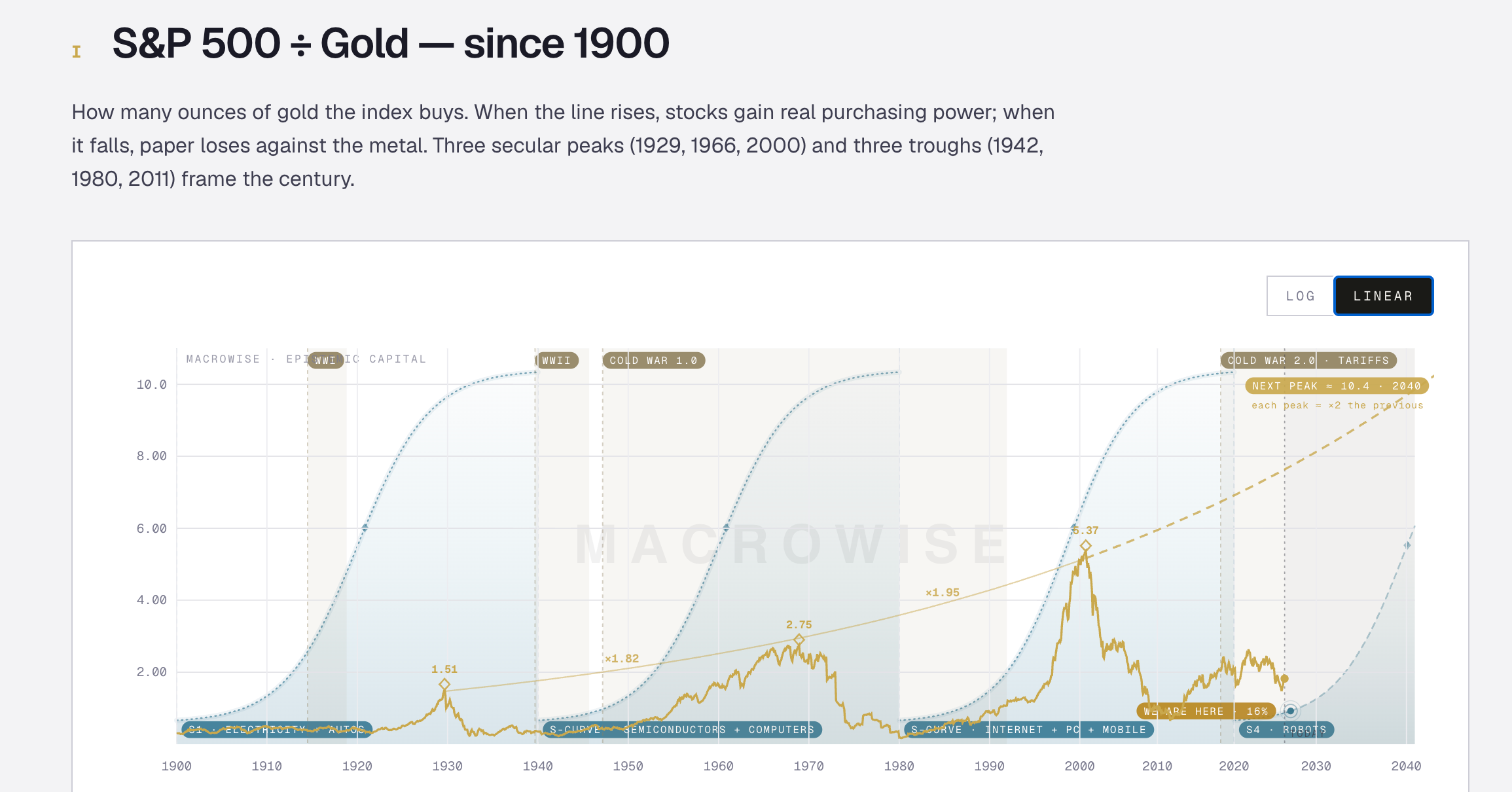
How many ounces of gold the stock market buys. Three peaks — 1929, 1966, 2000 — each roughly double the last. Three bottoms: 1942, 1980, 2011.
When the line rises, a civilisation is making new wealth. When it falls, it’s fighting over the wealth it already has.
Every climb sat on top of a real discovery age. Electricity and cars. Semiconductors and computers. The internet and mobile. Every fall was war, inflation, or redistribution — and gold won those, because gold is the only large asset that doesn’t depend on anyone keeping a promise.
That’s the instrument. If the discovery age is real, this line goes up for twenty years.
And here’s the tension. We’re building the largest technology stack in history while living through every symptom of a fighting-over-it period: tariffs, rival tech blocs, $39 trillion of US debt, electricity bills rising because of the buildout itself. The ratio has gone sideways for twenty-five years.
So the question is simply: does the discovery end the fight, or does the fight stop the discovery?
Digital gold for whom?
Bitcoin and Solana are on that map now, and they belong there. They’re not a separate asset class sitting beside this machine. They’re a layer of it.
But it forces an honest question:
The standard case says Bitcoin is digital gold. So the last eighteen months should have proved it: tariffs, blocs, debt, currency stress — perfect conditions. Gold did exactly what theory predicts. Bitcoin did not. It’s near $65,000, down about $53,000 from a year ago, with the worst ETF outflows on record in June.
It’s the wrong test.
Ask what gold actually does for the people who hold it. A central bank, a family office, a state — each already has a legal system, a bank account, courts, treaties, borders and a passport. Gold is the thing they hold when the promises in that system come under strain. It’s a hedge for an entity that already has everything else.
For that holder, Bitcoin’s distinctive properties are mostly irrelevant. Programmable? They have lawyers. Settles without a counterparty? They have correspondent banks. Verifiable by anyone? They have auditors. Bitcoin is competing for a job that is already well staffed, which is why it trades on liquidity — because for a twentieth-century institution, that’s genuinely all it is.
Now ask a different holder.
An autonomous agent cannot open a bank account. It cannot sue. It has no jurisdiction, no passport, no courts, no counterparty willing to be sued on its behalf. It cannot hold gold, because gold requires a vault and a vault requires a legal person.
What it needs is an asset and a settlement rail that are pure ontology — checkable by machine, no counterparty, no permission, no legal system underneath. That is the exact and only thing Bitcoin was built to be.
So it’s digital gold for digital beings. And digital beings are not here yet.
That reframes everything about the price. Bitcoin’s real customer base is gated by how much economic activity is conducted by non-humans — which today is approximately none. Look back at the layer chart: sensors at 9%, robots at 2%. The agentic economy sits on the two least-built layers of the machine.
We are pricing a reserve asset for an economy that hasn’t been born, using the behaviour we’d expect from a mature one.
Now — “it’s early” is what every failing thesis says, so this only counts if it can be wrong. Here’s how:
What would confirm it. Settlement volume between software agents becomes a real number, and as it grows, Bitcoin’s correlation to liquidity conditions falls. The asset starts trading on machine demand rather than on ETF flows.
What would kill it. The agentic economy arrives — real machine-to-machine settlement at scale — and it runs on stablecoins, or on a bank consortium rail, or on something not yet built, and Bitcoin keeps trading on the Fed. Then the slot existed and Bitcoin didn’t win it, which is a different failure from being early and a worse one.
Nothing before that fork is evidence. Everything written in the meantime is narrative, mine included.
One small note from the current data: in the month when the market punished everyone building physical infrastructure, Solana was +8.7% and Bitcoin +5.1% — both in the top half of the chain. Make of that what you like. One month is one month.
What to watch instead of earnings
Machines are now answering questions. They are not yet asking them. As Buzzard put it, the famous problems are named after the people who posed them, not the people who solved them — and when you ask a machine to invent a question, you get something boring, obviously true, or obviously false.
So the things worth tracking aren’t quarterly:
The rate of verified results. Not announcements — results that survive a checker. That number is the discovery age’s pulse.
New rows on the map. Not which link is winning this month, but whether links keep being added. AI Power wasn’t a category in 2023. The month that chart stops growing new rows is the month the mapping is finished.
Settlement between machines. The first real number for value moving between software agents, with no human approving it. That is the birth certificate of the economy Bitcoin was actually built for.
Whether the connecting layers get built. Ontologies and sensors. If they stall, the rest is a very expensive autocomplete.
Whether open borrowing stays legal. Restriction is the one policy choice that directly lowers the discovery rate.
The ratio. Twenty years of the stocks-to-gold line is the only scoreboard that has ever measured this correctly.
None of these appear on an income statement.
Earnings tell you how well a company solved the last problem. They tell you nothing about a company buying the ability to solve problems nobody has stated yet.
Two companies got punished last week for buying exactly that. Four days earlier, a machine had settled a question that had been open since 1939.
Both things are true. Only one of them will matter in ten years.
Thanks for reading,
Guillermo Valencia A
MacroWise Cofounder