
The Protein Hunters
Two hundred years of chasing the primary substance — and the eight weeks in 2026 when both hunts ended.
In April 2026, in a building in London, a small group of scientists pressed go on something nobody had ever done before. They injected a human being with a cancer drug that had been designed, almost entirely, by an artificial intelligence.
There was no press conference. No fireworks. The patient was anonymous. The company was called Isomorphic Labs, a spinout of Google’s DeepMind.
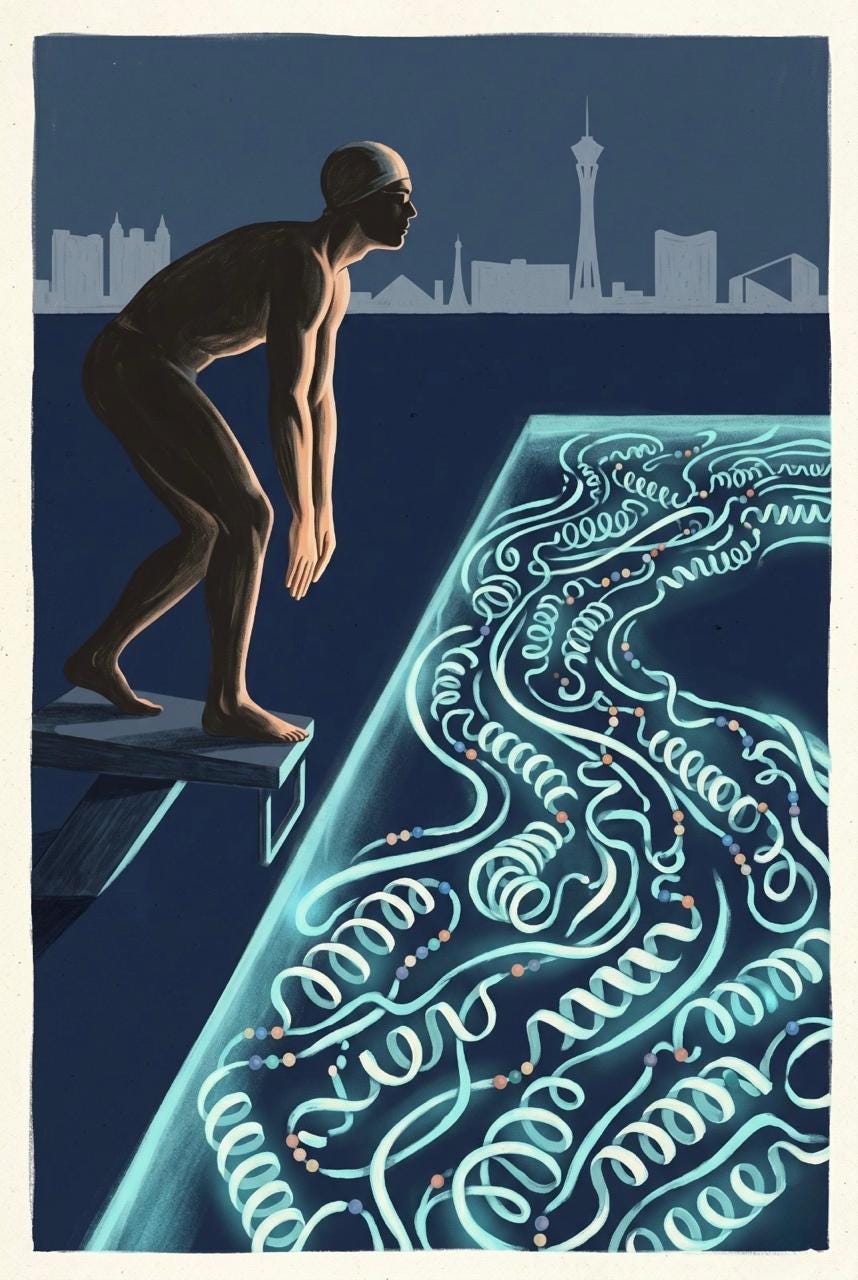
Six weeks later, in Las Vegas, on May 21st — eleven days from when you read this — forty athletes will gather at a purpose-built complex inside Resorts World. They will swim, sprint, and lift in front of 2,500 spectators. None of them will be drug-tested. Most have spent the last year openly taking compounds that would earn a lifetime ban from any Olympic federation on Earth. One has already broken a seventeen-year-old world record in the 50-meter freestyle. He took home a million-dollar check the same afternoon.
Two scenes. Six weeks apart. Both happening as you read this.
You will be told the first is a story about AI. The second is a story about doping.
Neither is correct.
They are the same story, told from opposite ends. They are the closing chapters of two hunts that began in the 1830s, that ran in parallel for two hundred years, and that — by historical accident or by inevitability, depending on how you read history — converge in this single eight-week window in 2026.
This is the story of both hunts.
It begins, as the best stories do, with an obsessive young man boiling egg whites in a Dutch laboratory.
I. The First Hunt: Reading the Primary Substance
Mulder, who named it
In 1838, Gerardus Mulder was thirty-six years old and angry.
He was a chemist in Utrecht, and he had a theory nobody believed. He thought he had found the most important substance on Earth. He thought it was hiding inside every animal that had ever lived. He thought it was made of just a few elements arranged in a simple repeating pattern.
He was wrong about almost everything. But he gave us the word.
Mulder spent his evenings boiling egg whites. Boiling blood. Boiling milk. Boiling muscle from butchered cattle. He’d burn what he distilled and measure what came out — carbon dioxide, water, and a peculiar amount of nitrogen. Plants didn’t have much nitrogen. Animals had a lot. Whatever this nitrogen-rich substance was, it seemed to be in everything that breathed.
He wrote to his friend Berzelius, the most famous chemist in Europe, asking what to call it. Berzelius — a man with the scientific equivalent of perfect pitch — wrote back with a suggestion from the Greek.
Protein. From protos. First. Primary. The most important.
Mulder published. The scientific establishment laughed. Within twenty years his single-formula theory was demolished. He retired bitter, convinced he had been cheated.
But the name stuck. And the intuition turned out to be correct, in the deepest possible way.
Proteins really are the primary substance.
They are what life is, when life does anything at all.
What a protein actually is
Forget your high school textbook. Here is what a protein is.
Take twenty different beads. Some big, some small. Some hate water, some love it. Some carry positive charges, some negative. String a few hundred of them together in a specific order. Drop the chain in salt water at body temperature.
The chain folds itself. Within milliseconds. Into a precise three-dimensional shape. Always the same shape. The shape is determined entirely by the order of the beads.
That folded shape is the protein. And the shape determines what the protein does. Some shapes form pumps that push molecules across membranes. Some form scissors that cut other proteins. Some form sensors that detect specific chemicals. Some form motors that walk along filaments dragging cargo.
You are made of about 20,000 different protein shapes, each in millions of copies, working at once. Right now. As you read this.
If they stop, you stop. In seconds.
Anfinsen, who proved the impossible
In 1961, a quiet biochemist at the NIH named Christian Anfinsen took a small enzyme from cow pancreas and gently unfolded it. He warmed it. He added a chemical that disrupted the weak forces holding the chain together. The chain became loose, floppy, useless.
Then he removed the disruption.
The chain folded itself right back up. Same shape every time. Function restored.
What Anfinsen had proven was almost mystical: the entire 3D shape was somehow encoded in the 1D sequence of beads. The information for how to fold was already there, in the order. The water and the laws of physics did the rest.
He won the Nobel Prize for it in 1972.
But there was a paradox.
A 100-bead chain has roughly 10⁹⁵ possible shapes. If the chain randomly tried each shape one after another, even at the maximum speed physics allows, it would take longer than the age of the universe to find the correct one.
But it folds in milliseconds. Every time.
Something was guiding the chain. Something we couldn’t see. The puzzle haunted the field for thirty years.
Arnold, who gave up trying to understand
In the 1980s, a chemical engineer at Caltech named Frances Arnold was trying to do something everyone said was impossible: build an enzyme by hand.
She’d study a natural enzyme, figure out which amino acids did what, propose changes. Almost every change made things worse. After years of failure, she gave up.
Or rather: she gave up on understanding it. Then she did something brilliant.
She decided to breed it.
She took the gene for an enzyme. She copied it sloppily, on purpose, so each copy had a few random typos. This produced a population of slightly different enzymes — some better, some worse, most about the same. She put the population under stress. Whatever conditions she wanted the enzyme to survive — that was the test. The survivors, she kept. The rest, she threw out. Then she copied the survivors sloppily and ran the whole thing again.
She called it directed evolution.
It was brutally simple. It also worked beautifully. Each round of selection improved the enzyme a little. Ten rounds turned a useless enzyme into a champion.
Arnold won the 2018 Nobel Prize in Chemistry. In her lecture she said something I want you to remember:
“I did not design the protein. I bred it. The way one breeds a racehorse — selecting the individuals that ran fastest, generation after generation, until the final horse was a thing that ran faster than anything nature had produced.”
When a system is too complex to understand, you don’t have to give up. You can build a loop — variation, selection, repeat — that produces good answers without anyone understanding why they’re good.
Hold that idea. Forty years later, a former chess prodigy in London applied the same idea on a much larger scale, to the problem nobody had cracked since Anfinsen.
Hassabis, who solved it with learning
In 2010, Demis Hassabis founded a London startup called DeepMind. He had been a teenage video game designer, then a neuroscientist who got a PhD studying human memory. His goal — and he said this openly — was to solve intelligence and then use it to solve everything else.
In 2014, Google bought DeepMind. Over the next six years, Hassabis’s team became famous for games. AlphaGo defeated the world’s best Go player. AlphaZero taught itself chess in four hours.
What Hassabis needed was for the same architectures to crack a real scientific problem. The choice was obvious. Protein folding had been the canonical hard problem in biology for fifty years. Hundreds of laboratories. Thousands of careers. Billions in funding. Nobody had solved it.
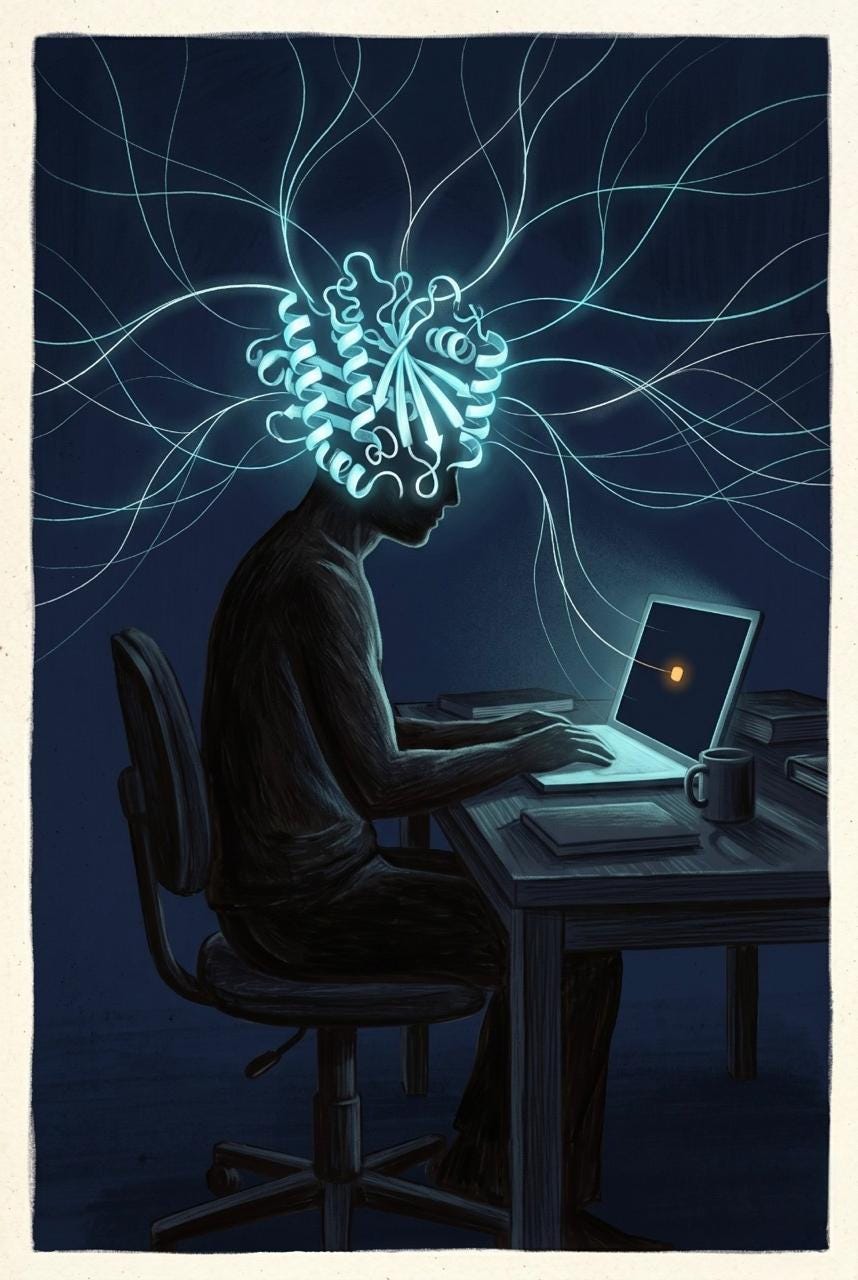
In December 2020, DeepMind submitted a system called AlphaFold 2 to the biennial CASP contest, where labs predict structures that have been experimentally solved but kept secret.
A random guess scored around 20. A decent prediction in the late 2010s scored about 55. A score of 90 was considered roughly indistinguishable from experimental measurement — and considered impossible.
AlphaFold 2 scored 92.
For most proteins, the predictions were better than what the experimentalists had measured. For some, the AI corrected mistakes the experimentalists had made.
John Moult, the man who had run CASP since 1994, opened the conference with a sentence that flew around the world: “In some sense the problem is solved.”
Fifty years of failure. Then in twelve weeks, ended.
They did not use physics. They used learning. The same epistemological move Arnold made when she stopped trying to understand enzymes and started breeding them.
In July 2021, DeepMind released the AlphaFold Database publicly. Free. Two hundred million predicted structures — practically every protein ever sequenced. The bottleneck of structural biology, painstakingly scaled one molecule at a time over sixty years, dissolved overnight.
In 2024, Hassabis and his lieutenant John Jumper won the Nobel Prize in Chemistry. The first Nobel for work primarily driven by an AI system.
Baker, who reversed the arrow
While DeepMind was solving prediction, a chemist in Seattle was solving the harder problem.
If you can predict the structure of any protein from its sequence, can you do the reverse? Given a structure you want, can you design a sequence that produces it?
That’s not prediction. That’s design. And it’s much harder.
David Baker has been working on this since the 1990s. In 2003, after years of effort, his lab designed a protein from scratch — a sequence with no relationship to any natural protein, computed entirely on a server. They synthesized it. They crystallized it. They confirmed by X-ray that it folded into exactly the shape they had designed.
They called it Top7. It was small, useless, and unprecedented. It was the first protein humanity had ever written.
In 2023 Baker’s lab released RFdiffusion, which applied the same diffusion-model trick that powers DALL-E and Midjourney to protein design. You give it a target — I want a protein that binds this region of the human EGFR receptor — and it proposes a 3D shape. A second program finds the amino acid sequence that produces that shape. The protein is synthesized within weeks and tested.
Success rates went from 1% to over 50%.
For the first time in history, designing a protein was easier than building it.
In 2024, Baker won his share of the Nobel Prize alongside Hassabis and Jumper.
Isomorphic, April 2026
In 2021, Alphabet — Google’s parent — quietly spun out a new firm called Isomorphic Labs, with Hassabis as CEO. The mission: take everything DeepMind had built for biology and use it to design new medicines.
In 2024, Isomorphic published AlphaFold 3 — which can predict, with reasonable accuracy, how a candidate molecule binds to a protein target. That is what drug discovery is. The same year, Isomorphic signed partnerships worth $1.2 billion with Novartis and $1.7 billion with Eli Lilly.
In April 2026, Isomorphic announced that it was beginning human clinical trials for cancer drugs designed with its AI platform.
Read that again.
A drug designed primarily by an artificial intelligence is being tested in human beings, this month, in London.
This is the threshold the first hunt crossed.
Mulder boiled an egg white and named the substance. Anfinsen proved the sequence contained the shape. Arnold bred enzymes she could not understand. Hassabis taught a machine to predict the fold. Baker taught the machine to write the sequence. Isomorphic took what the machine wrote and put it into a vein.
The first hunt is over.
The hunters won.
II. The Second Hunt: Writing the Primary Substance
While the first hunt was learning to read proteins, a second hunt was learning to use them — as drugs. As signals you could put in a syringe. As instructions you could give the body in a language it already spoke.
This second hunt is older than you think and more recent than you think.
Banting, who saved the children
In 1921, a Canadian surgeon named Frederick Banting and a medical student named Charles Best, working in a borrowed laboratory at the University of Toronto in the summer heat, ground up dog pancreases and extracted from them a substance that could lower blood sugar in diabetic dogs.
The substance was insulin. A small protein. Fifty-one amino acids long.
Before insulin, type 1 diabetes was a death sentence. Children diagnosed at eight were dead by eleven, emaciated, blind, in a coma. The accepted treatment was a starvation diet that bought you months.
In January 1922, Banting and Best gave insulin to a fourteen-year-old boy named Leonard Thompson, dying in a Toronto hospital. Within days he was eating, walking, regaining weight.
Banting and his collaborator J.J.R. Macleod won the Nobel Prize in 1923. The fastest Nobel ever awarded.
Insulin was the first peptide drug. The first time a chain of amino acids, extracted from one species and given to another, had cured a disease.
It would not be the last.
Hodgkin, who pictured it
For forty years after Banting, insulin was extracted from pig and cow pancreases. Nobody knew its 3D shape. Nobody could engineer it. You took what nature gave you.
Then a woman in Oxford named Dorothy Hodgkin spent thirty-five years staring at X-ray photographs.
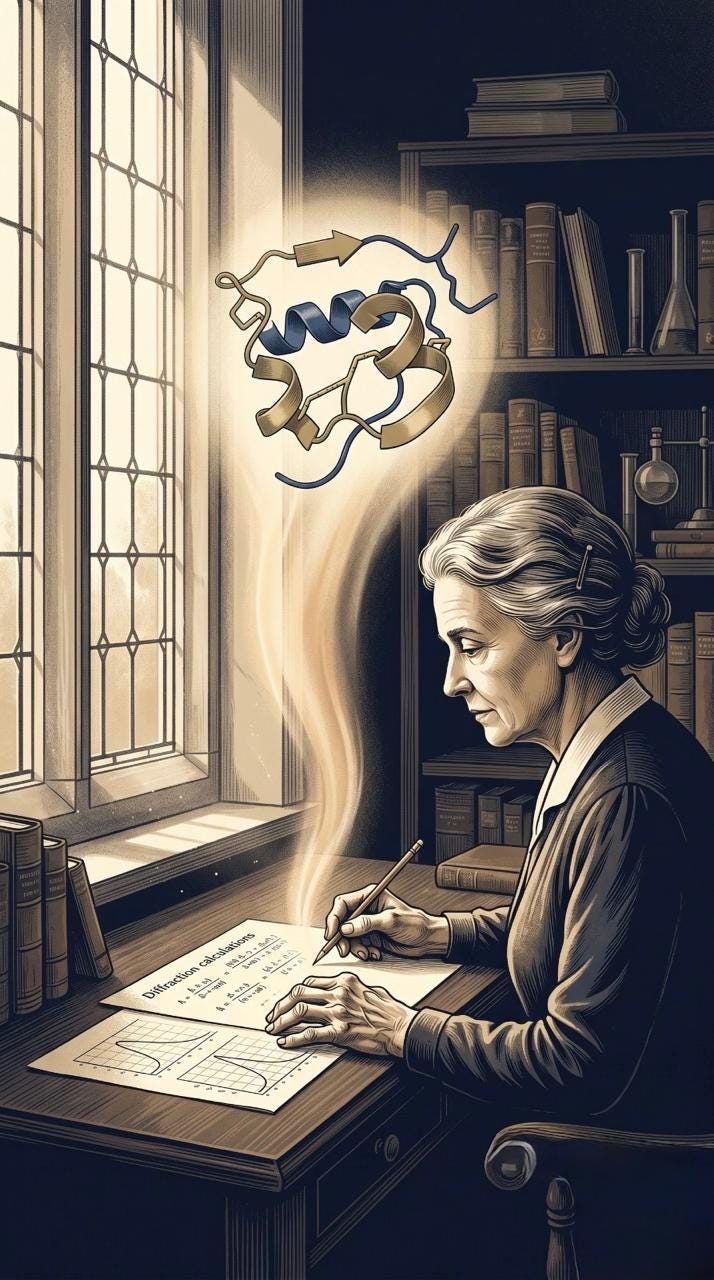
She had taken the first X-ray photograph of a crystallized protein in 1934, at age twenty-four, the digestive enzyme pepsin. She solved penicillin in 1945. She solved vitamin B12 in 1956 and won the Nobel for it in 1964 — the only British woman ever to win a science Nobel.
She solved insulin in 1969. She did her last calculations by hand, with her son Toby, with rheumatoid arthritis twisting her fingers into claws.
For the first time, anyone could see what insulin looked like.
In 1978, a small startup in California called Genentech used the new tools of genetic engineering to make human insulin in bacteria. By the mid-1980s, every diabetic in the developed world was on synthetic insulin. The pigs were retired.
The hunt had moved from extraction to synthesis. The molecule was no longer something you stole from an animal. It was something you wrote into bacterial DNA and harvested.
Holst and Habener, who found the satiety signal
In the 1980s, two doctors on opposite sides of the Atlantic — Jens Juul Holst in Copenhagen and Joel Habener in Boston — independently isolated a small peptide that came out of the intestine after a meal.
Thirty amino acids long. They called it GLP-1.
It did several things at once. It told the pancreas to release insulin. It told the stomach to empty more slowly. It told the brain you were full.
A chemical signal that said: you just ate; you’re satisfied.
The problem: natural GLP-1 broke apart in the bloodstream within minutes. Useless as a drug.
Novo Nordisk, who engineered the signal
A Danish company called Novo Nordisk — the descendants of Banting’s first commercial licensees, who had been making insulin from pig pancreases for fifty years — spent the next two decades engineering GLP-1 to last longer. They attached fatty acids so it would stick to blood proteins. They tweaked specific amino acids so enzymes couldn’t chop it up.
By 2017 they had a version that lasted a week in the bloodstream after a single shot.
They called it semaglutide. They sold it as Ozempic.
What happened next is the most important commercial fact of the decade. Patients didn’t just control their diabetes. They lost weight. A lot of weight — fifteen, twenty, thirty percent of body weight, sometimes more. Eli Lilly’s competing peptide, tirzepatide, did even better.
By 2025, Lilly’s revenue hit $65 billion, growing 45% a year. Mounjaro and Zepbound combined for $11.7 billion in a single quarter. Novo Nordisk became, briefly, the most valuable company in Europe — larger than LVMH, larger than ASML.
A peptide thirty amino acids long, dosed at one ten-millionth of a gram per shot, created hundreds of billions of dollars in market value and changed the biology of obesity for tens of millions of people.
This was the proof of the second hunt.
The middle category — proteins small enough to synthesize cheaply but big enough to be specific — turned out to be where the leverage lived. Not a drug or a hormone or a supplement, exactly. Something newer than that.
A signal you could buy.
There are thousands of natural peptide signals in the body. We have turned maybe a dozen into drugs. The next thousand are about to come much faster than the first dozen did — because the first hunt has now armed the second.
D’Souza, May 2026
The conventional name for a peptide that fixes a disease is medicine.
The conventional name for the same peptide given to someone who doesn’t have the disease is doping.
The conventional name for the same peptide given to someone who wants to age more slowly is enhancement.
These are not biological categories. They are regulatory and cultural categories. The molecule is the same molecule. The receptor is the same receptor. The signal is the same signal.
This is the wedge that an Australian lawyer named Aron D’Souza is driving into the system.
D’Souza runs two parallel projects from New York. The first is the Enhanced Games — the four-day Memorial Day weekend Vegas spectacle that opens in eleven days, with $25 million in prize money, backed by Peter Thiel, the Winklevoss twins, and Donald Trump Jr.’s 1789 Capital, condemned by the IOC and WADA, and headlined by The Killers.
The second, less covered but vastly more important, is a telehealth company called Live Enhanced.
Live Enhanced is a performance medicine subscription. Virtual consultation with a clinician. Bloodwork. Prescription. Compounded peptides shipped to your door, monthly, with auto-refill. The catalog runs through GLP-1s for body composition, BPC-157 for tissue repair, CJC-1295 and ipamorelin for growth hormone secretion, thymosin alpha-1 for immune modulation. As of April 28th, 2026 — twelve days ago — they added a prescription-dosed topical GHK-Cu copper peptide for skin and recovery, at $119 a month.
Read the framing carefully. Every one of these is a naturally occurring peptide that declines with age. Every prescription is clinician-supervised, lab-monitored, individually dosed. Every compound is, technically, legal — prescribable by a licensed physician under existing US compounding pharmacy law.
The Games are the marketing budget. Live Enhanced is the company.
This is the move, and it is more elegant than it looks. You don’t argue with the regulator. You don’t lobby Congress. You don’t fight WADA. You build a parallel competition in a city that allows it, with athletes who consent, with science that is — controversially but defensibly — legitimate. You point at the participants and say: these people are not sick. They are using prescription-grade peptides under medical supervision. They are getting faster, stronger, healthier. By what argument is this different from Ozempic? By what argument is Ozempic different from this?
There is no clean answer.
The traditional answer was: drugs treat disease. But the FDA approved semaglutide for chronic weight management at a BMI threshold that captures roughly half of American adults. Lasik corrects vision for people who could wear glasses. Statins are prescribed at thresholds that capture most middle-aged men. Testosterone replacement is a billion-dollar telehealth category for men whose levels are low-normal.
The line between treatment and enhancement is not a wall. It is a slope. Every decade, the threshold for treatment shifts a little further into what used to be enhancement. D’Souza is accelerating the slope and being honest about it.
His specific bet — the regulatory arbitrage at the heart of the company — is this: the United States already permits compounded prescription peptides under physician supervision. The infrastructure for telehealth prescribing was built during COVID and has not been rolled back. The demand exists, demonstrably, because the gray-market peptide industry is already a multi-hundred-million-dollar business of people buying research-grade vials from sketchy websites and injecting themselves without supervision. Enhanced converts that gray market into a regulated, monitored, brand-name one.
Banting injected insulin and saved a child dying of diabetes. D’Souza is selling growth hormone secretagogues by subscription to a software engineer who wants to recover from his deadlifts faster.
These are not the same act. But they are the same molecular class. And the line between them is moving.
The second hunt is also over.
The hunters also won.
III. What Both Hunts Mean
Here is what the next ten years look like, with high probability.
More peptides, faster. AlphaFold 3 and RFdiffusion — the tools the first hunt produced — mean candidate peptides for any target can now be generated in weeks rather than years. The cost of inventing a new candidate has fallen by roughly two orders of magnitude in the last thirty months. The pipeline is filling. Retatrutide, with up to 28.7% weight loss in Phase 3. Survodutide. Orforglipron. Pinnacle Medicines raised $89 million in March specifically for AI-designed oral peptides. Generate Biomedicines signed a $1 billion partnership with Novartis to design peptides and antibodies de novo.
More categories, blurrier lines. The GLP-1 receptor is just one signal. There are receptors for satiety, muscle growth, fat oxidation, sleep depth, cognitive sharpness, skin turnover, tissue repair. Most have a peptide somewhere in the body that already activates them. We will engineer better versions of all of them. Some will be marketed as drugs, with FDA approval, for specific diseases. Many — most, eventually — will be sold the way Live Enhanced sells GHK-Cu: prescription, telehealth, monthly, indication-flexible.
More cultural normalization. Ozempic broke the seal. Once a critical mass of professionally successful people are openly on a peptide protocol — and they are; you have already met them — the social cost of not being on one starts to invert. The same generation that views non-vaccination as antisocial will, in fifteen years, view non-enhancement as a kind of negligence.
More risk. Long-term safety data on most of these compounds is genuinely thin. GLP-1 agonists have a decade of cardiovascular data and they look good. Most of the rest have animal studies, small human trials, and a lot of n-of-one anecdotes. Some of the people taking them now will, in twenty years, regret it. We will not know which ones in advance.
The honest framing is that we are running an open-label, undermonitored, civilization-scale experiment on the human peptide system. The experiment is happening whether or not anyone gives it permission. The only real question is whether it happens through telehealth subscriptions with bloodwork and clinical supervision, or through Telegram channels and unmarked vials.
The supervised version wins. That’s the bet.
Coda
Two hundred years ago, Mulder boiled an egg white and named the most important substance on Earth. He was right that it was primary. He was wrong about almost everything else.
What he could not have imagined is that the primary substance would, by 2026, be something we write.
Not just discover. Not just extract from a pancreas or a gut wall. Write. Letter by letter, like English. With predictions of how the sentence will fold into meaning. With factories that synthesize the meaning at cents per dose. With telehealth clinicians who prescribe the meaning by mail.
In April 2026, in London, a cancer patient received an injection of a molecule that no human being had designed. A machine had written it. The first hunt — Mulder, Anfinsen, Arnold, Hassabis, Baker — ended in that vein.
In May 2026, in Las Vegas, a swimmer will take a peptide protocol that would have ended his career two years ago and try to swim 50 meters faster than any human ever has. He will probably succeed. The IOC will denounce it. The crowd will cheer. The Killers will play. The second hunt — Banting, Hodgkin, Holst, Novo, D’Souza — ended in that pool.
Two hunts. Two hundred years. Six weeks apart.
You are alive at exactly the moment when both ended.
Most days this will not feel important. Most days you will hear about something else — a new model, a war somewhere, the price of eggs. But ten years from now, when a friend’s cancer is treated by a binder that did not exist before 2025, when your father’s recovery from surgery is faster because of a peptide that did not exist before 2027, when your own body composition at fifty looks like it used to at thirty-five — you will know that you watched the moment.
Mulder named it. Banting injected it. Anfinsen explained it. Hodgkin pictured it. Holst found the satiety signal. Arnold bred it. Hassabis predicted it. Baker wrote it. Novo sold it. D’Souza is making it ordinary.
The primary substance, two hundred years on, remains the first.
But now, for the first time —
It is also ours.
— Guillermo Valencia A
Cofounder MacroWise
Risk is not volatility. It is the atrophy of learning. And that atrophy is measured by the speed of recovery.
Ufff
Brutal Guille!! Estamos viviendo un momento épico. Que momento para la humanidad.