
The Simulation of Value: Why Crypto is the First “Internet City”
From the canals of Amsterdam to the blocks of Solana—how the Game of Life explains the emergence of a new financial geography.
The Grid and the Ghost
In 1970, John Conway drew a grid, defined four simple rules, and watched a universe emerge. He called it the Game of Life.
The lesson of his game was startling: You do not need a master plan to create complexity. You do not need a god to design a glider. You just need agents (cells), interactions (neighbors), and time (iterations). If the rules are right, order emerges from chaos.
For the last 400 years, our financial “grid” has been defined by a rigid hierarchy: Nation-States, Central Banks, and their gatekeepers, the Commercial Banks. This system operates like a fortress—top-down, permissioned, and slow. But we are currently watching a new pattern emerge on the board. It is not a country. It is not a corporation. It is a new asset class called Crypto, and it behaves less like a stock market and more like a living, digital city.
To understand where Bitcoin, Solana, and Stablecoins are taking us, we have to stop looking at the “prices” and start looking at the “rules” of the simulation.
1602: The First Emergence
The last time the board changed this drastically was in 1602. Before then, value was locked in land and gold, controlled by Kings (the ultimate “Still Life” pattern—stable but stagnant).
Then, in Amsterdam, a new rule was introduced: The Joint Stock Company. The Dutch East India Company (VOC) wasn’t just a business; it was a new technology for organizing human cooperation. It allowed strangers to pool risk. Suddenly, liquidity exploded. The “neighbors” on the grid could interact in ways they never could before.
Crypto is not just “digital money”; it is the 1602 moment for the Internet. Just as the stock market allowed us to trade equity in a company, crypto allows us to trade equity in a protocol—a digital infrastructure. We are witnessing the birth of Internet Capital Markets.
Empires Die, Cities Survive
Why do empires fall while cities endure?
Empires (Rome, The British Empire, the USSR) follow a biological cycle: Rise, Growth, Maturity, Decay. They become too rigid, too top-down. In the Game of Life, they are “Overcrowded”—they stifle their own neighbors and die.
Cities (London, Istanbul, New York, Dubai) are different. They are Serendipity Engines. They operate on “superlinear scaling”—the bigger they get, the more innovative they become. They survive because they are defined by interaction, not control.
Crypto protocols like Solana or Ethereum are not companies. They are Digital Cities.
Solana is a high-frequency trading metropolis; Ethereum is a sprawling, bureaucratic capital. They provide the pavement and the laws (smart contracts), but the “buildings” (DeFi apps) and “citizens” (users) build themselves. This is a new geography. The financial industry is migrating from the physical geography of Wall Street (Empire-based) to the digital geography of the Blockchain (City-based).
The New Geography: Dubai, Abu Dhabi, and the Cloud
However, digital cities still need physical ports.
As the “Empire” of the traditional West faces its cycle of decay—burdened by debt and regulatory overreach—new physical jurisdictions are rising to host this new structure.
Dubai and Abu Dhabi are positioning themselves as the “interface nodes.” They understand that in a world of digital capital, the physical location that wins is the one that acts most like a neutral platform—a place where the digital “Gliders” can land safely. They are becoming the Venice of the 21st Century: small, agile, and essential to the flow of trade between the old world and the new.
The Geopolitical Bet: USD vs. Gold
The Great Powers are currently placing their bets on this new grid, trying to influence the simulation.
The US Bet: The United States has realized it cannot stop the crypto-rails. Instead, it is co-opting them. By allowing Stablecoins (USDC/USDT) to proliferate, the US is using crypto layers to expand the dollar’s dominance offshore. They are using the “Birth” rule of Conway’s game: if enough neighbors use Dollars, the whole grid turns Green.
The China Bet: China is playing a different game. They are pushing for a Digital Yuan, likely backed eventually by Gold. They are betting on a “Stable” pattern—hard assets, centrally controlled, immune to the chaotic volatility of the western algorithm.
The Source Code of the Market: A Simulation
This isn’t just a metaphor. We can literally write the code to prove it.
If we take Conway’s “Game of Life” and modify the variables for financial markets, we can build a primitive simulation of human greed and fear. I have written a simple Python script to visualize this. In the video below, you aren’t seeing random noise; you are seeing the “physics” of a market in motion.
The Setup:
Green Pixels: Traders who are Buying (Long).
Black Space: Traders sitting in Cash (Sidelines).
The Rules (The Algorithms of Human Nature): The simulation runs on three simple logic gates that mirror trader psychology:
FOMO (The Birth Rule): If a trader in cash sees exactly 3 neighbors buying, they get greedy and buy too.
Panic (The Crash Rule): If a buyer sees too many neighbors buying (Overcrowding), they fear a bubble and sell.
Isolation (The Liquidity Rule): If a buyer has no neighbors (no volume/support), they lose confidence and sell.
The Result: Watch the video. You will see “clusters” of buying that form spontaneously—these are Bubbles. You will see them expand and then suddenly pop, reverting to black silence—these are Corrections. Occasionally, you will see a stable pattern that moves diagonally across the screen—a Trend or “Glider.”
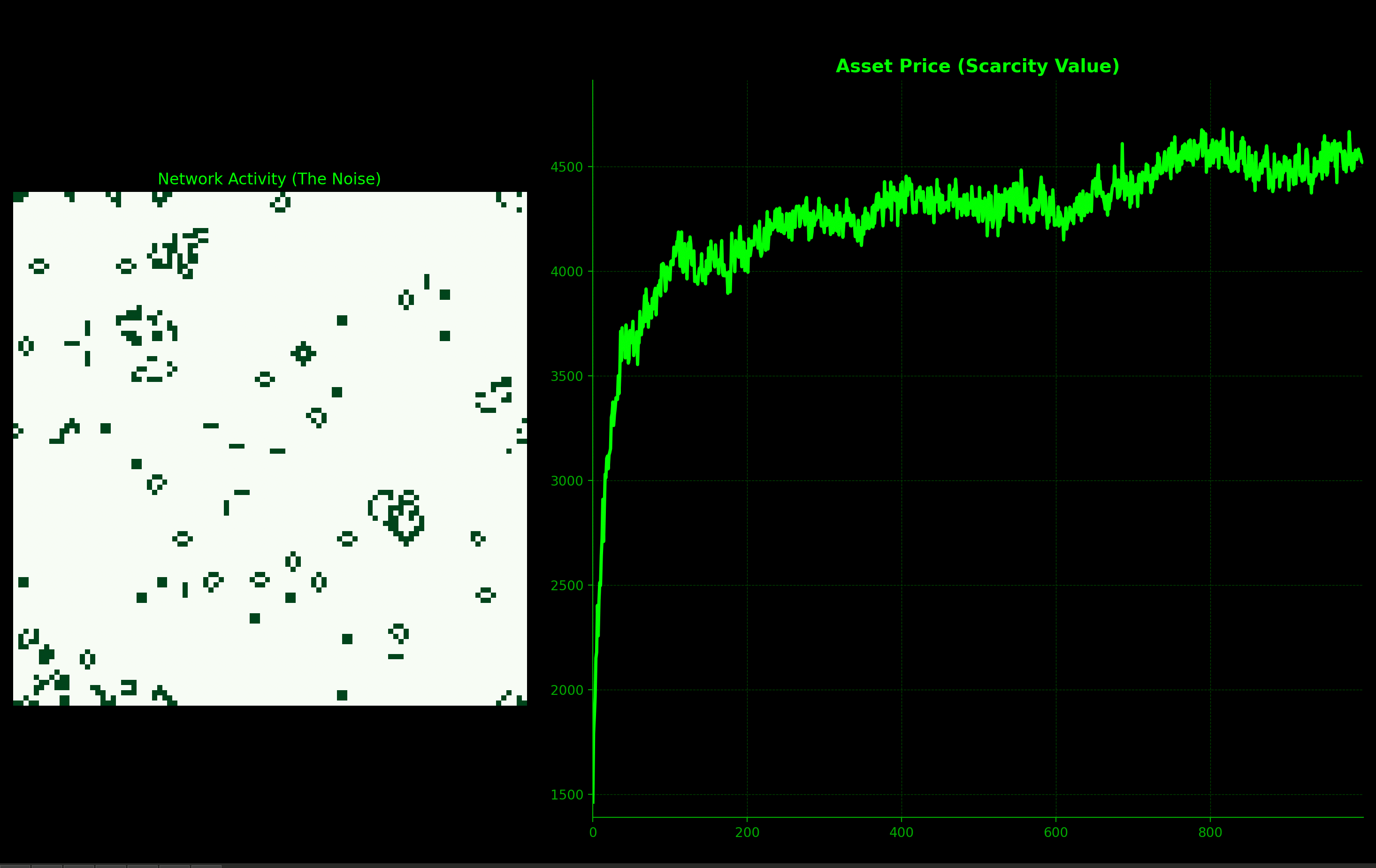
This simulation has no Central Bank. No President. No SEC. Yet, it creates a functioning, breathing market cycle purely from peer-to-peer interaction. This is the logic of the future economy.
The Objective is the Process
We look at the chaos of the markets—the volatility of memecoins, the collapse of FTX, the rise of ETFs—and we ask: “What is the point? Where is this going?”
Conway’s Game of Life teaches us that we cannot know the objective. There is no “final level.” There is only the process.
We are running millions of social agent simulations in real-time. Every transaction on the blockchain is a “cell” updating its state. We are testing which rules of governance, consensus, and value transfer allow the grid to thrive and which cause it to collapse.
Is life a simulation? Perhaps. But if it is, we are the agents. And for the first time in history, we have been given the tools to rewrite the source code of how we exchange value.
The rules are simple. The outcome is infinite. Press Run.
Kind regards ,
Guillermo Valencia A
Cofounder of MacroWise
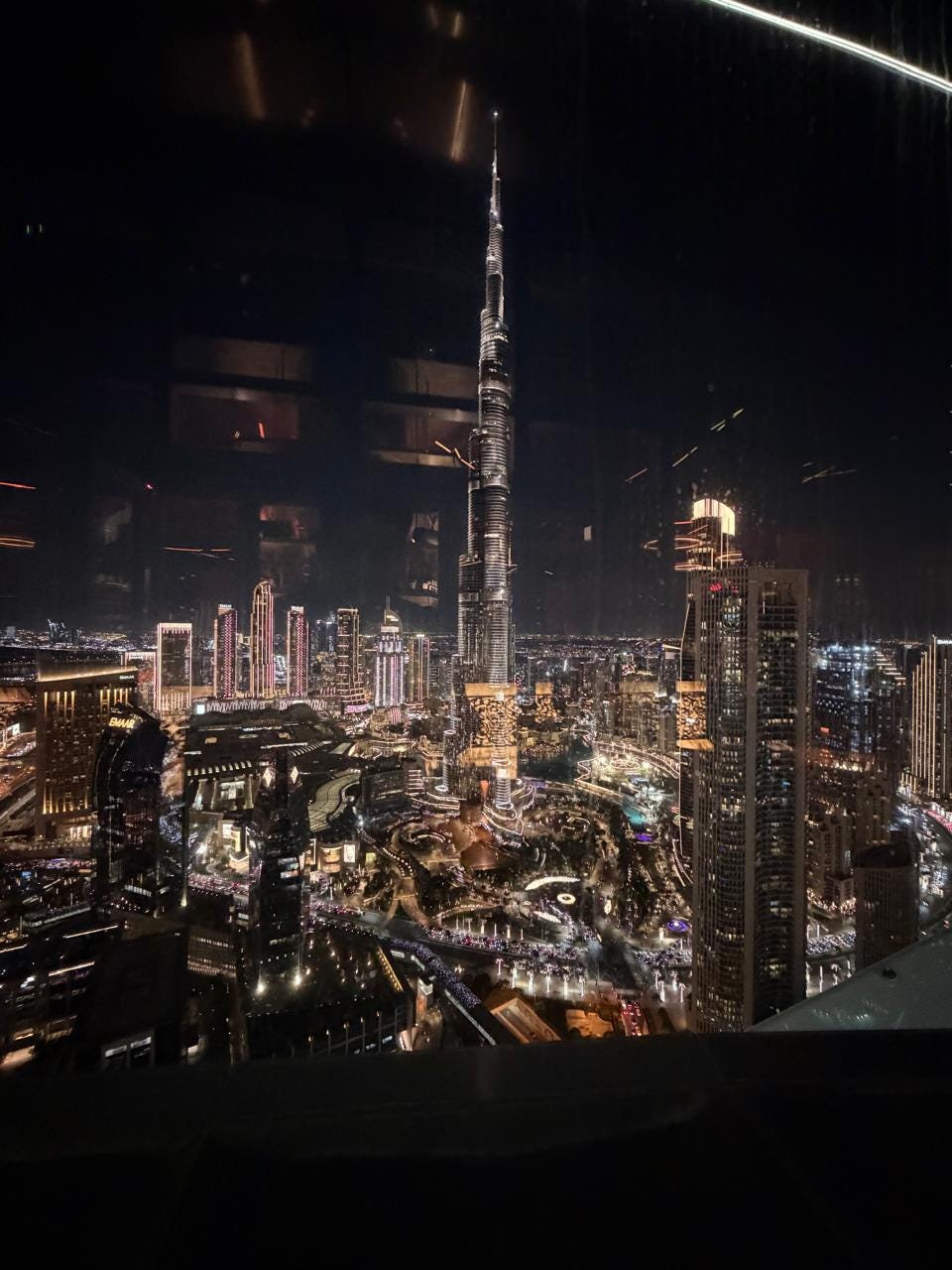
Dubai December 15th, 2025
Guillermo! Tremendo escrito. Nos muestra algo que los Estados no quieren que sepamos: genera más valor un vecino chismoso que un Banco Central! Un abrazo
Couldn't agree more. That Game of Life comparison for crypto is just brilliant, it really makes you think about how crucial those underlying rules are, especialy when everyone just looks at the prices. Thanks for laying it out so clearly, this perspective is super valuable for anyone trying to grok the future of decentralized systems.