
A quick note.
I publish every Sunday. The silence between posts is part of the work — most weeks the market is noise.
This week is different. The biggest IPO in history trades Friday. Anthropic and OpenAI filed for theirs seven days apart. The rules of the stock market were literally rewritten for one company.
When the signal spikes, I publish. Back to Sundays after.

This Friday, SpaceX starts trading. Ticker: SPCX. Price: $135. Valuation: $1.75 trillion.
Every headline calls it the space IPO of the century.
Every headline is missing the move.
Everyone is asking the same question: is it worth that?
Honest answer? No. Not today. It loses $5 billion a year. It trades at 92 times sales. One respected research firm says fair value is less than half the price.
But “is it worth it” is the wrong question.
The right question is: what is Musk actually doing?
Stay with me. This gets good.
The company is not what you think
Open the filing and SpaceX is not a rocket company. It’s four businesses wearing one ticker:
Starlink — satellite internet. 10 million users. $11.4 billion in revenue. 63% margins. The only part that makes money.
Launch — the rockets. They earn $4 billion and spend almost all of it building the next rocket.
Starship — the giant rocket. A lottery ticket on the entire future space economy.
xAI — Musk’s AI company, now folded inside. It made $3.2 billion and lost $6.4 billion.
Read that again. The AI business loses more than the satellite business earns in operating profit.
So why would Musk strap a money-burning AI company to his crown jewel right before going public?
Because he’s not playing the game you think he’s playing.
The three wars
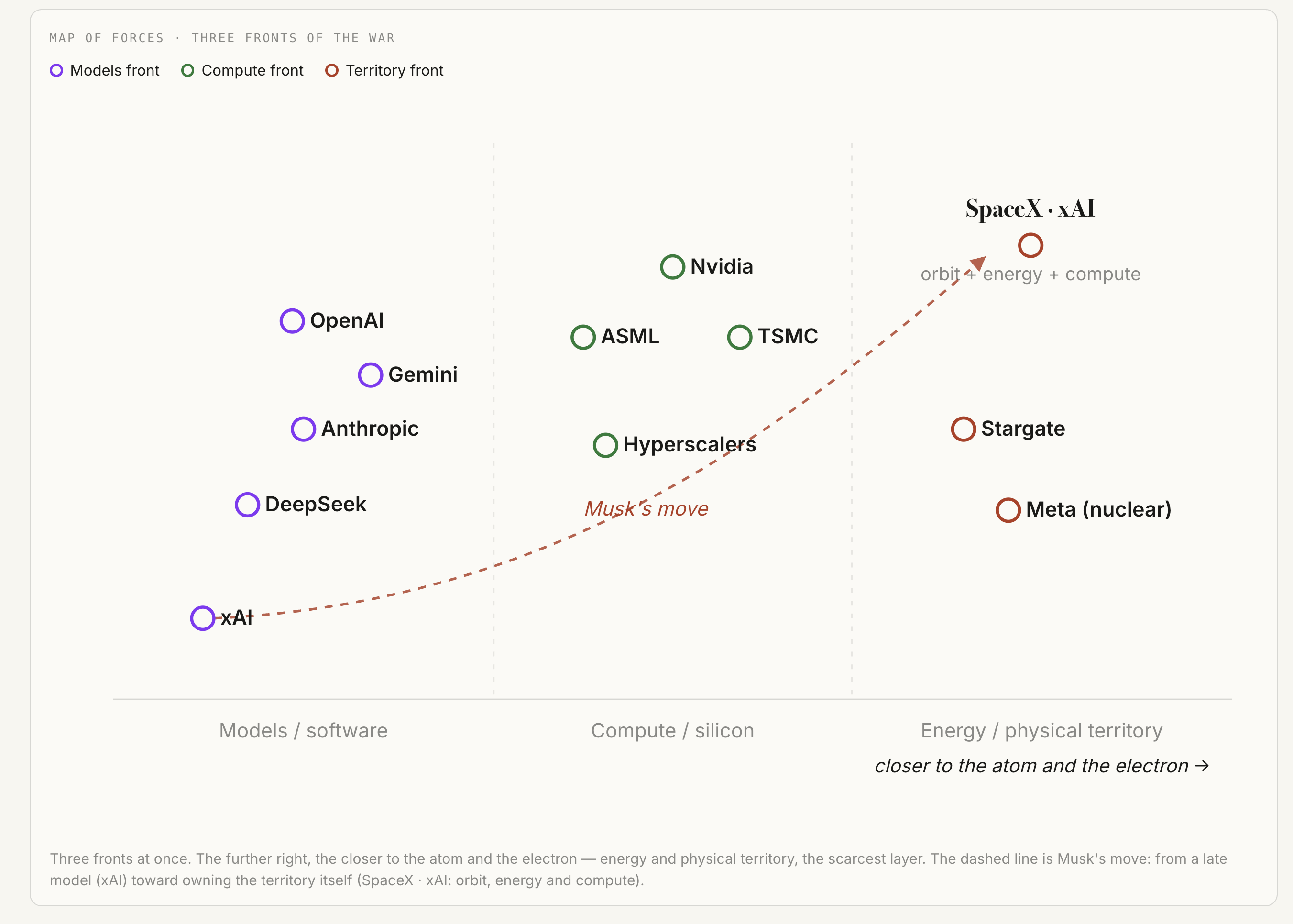
Everyone believes the AI war is one war: who builds the smartest model. OpenAI vs. Anthropic vs. Google vs. xAI.
In that war, xAI is losing. Last in revenue. Deepest in losses. The team was fired and rebuilt mid-fight.
But that’s only the first war. There are three:
War 1 — Models. The labs, copying each other, burning billions, racing to the same place. Brutal. Low margins. No winner yet.
War 2 — Chips. Nvidia, TSMC, Broadcom, ASML, Marvell. They don’t fight. They sell weapons to every side. Smart.
War 3 — Territory. The one nobody maps. Every AI model needs a physical home: land, electricity, cooling, connection. The stuff you can’t download.
Musk looked at War 1, saw he was losing, and did something nobody expected.
He didn’t retreat.
He changed wars.
The landlord move
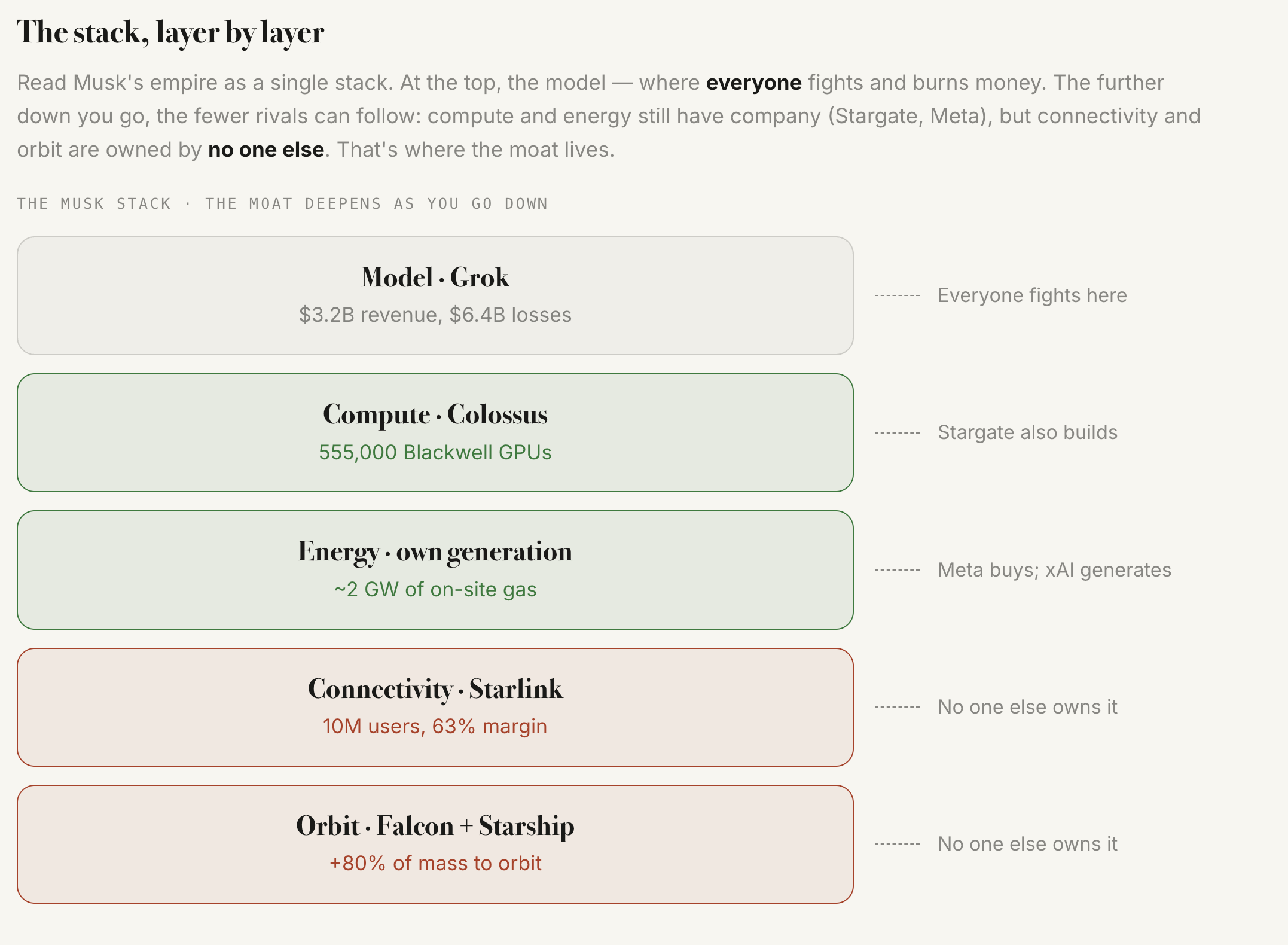
While the labs fight over models, look at what xAI actually built:
The largest single AI training site on Earth. 555,000 of Nvidia’s best chips. $18 billion in silicon alone.
2 gigawatts of power — what a city of 1.5 million homes consumes.
Its own gas turbines on-site. Everyone else waits years for the power grid. Musk doesn’t wait.
Built in 19 days what takes the industry 4 years.
He’s not trying to sell you a chatbot.
He’s becoming the landlord — the owner of the building where intelligence lives.
And here’s the part no competitor can copy. Stack the company from top to bottom:
Model → Compute → Energy → Connectivity → Orbit.
OpenAI is building compute. Meta is buying nuclear power. But nobody — at any price — owns the bottom two layers. Starlink is the connection. The rockets are the orbit.
One company owns the entire stack.
Everyone is fighting the AI war. Musk is buying the battlefield.
Now the part that makes traders sweat
Here’s where it stops being a story and becomes mechanics.
When SpaceX lists, only 3–4% of the company will actually trade. Everything else is locked for 366 days. At $1.75 trillion, that’s roughly $60 billion of available stock.
Sounds like a lot. It isn’t. Watch:
The Nasdaq changed its rules this year so giant IPOs enter the Nasdaq-100 index in just 15 days. Russell: 5 days. What does that mean in plain English? Every index fund tracking those benchmarks — the funds in your retirement account — is forced to buy. No opinion. No analysis. The rules say buy, they buy.
Estimated forced buying in the first weeks: $22–30 billion.
Against $60 billion of available stock.
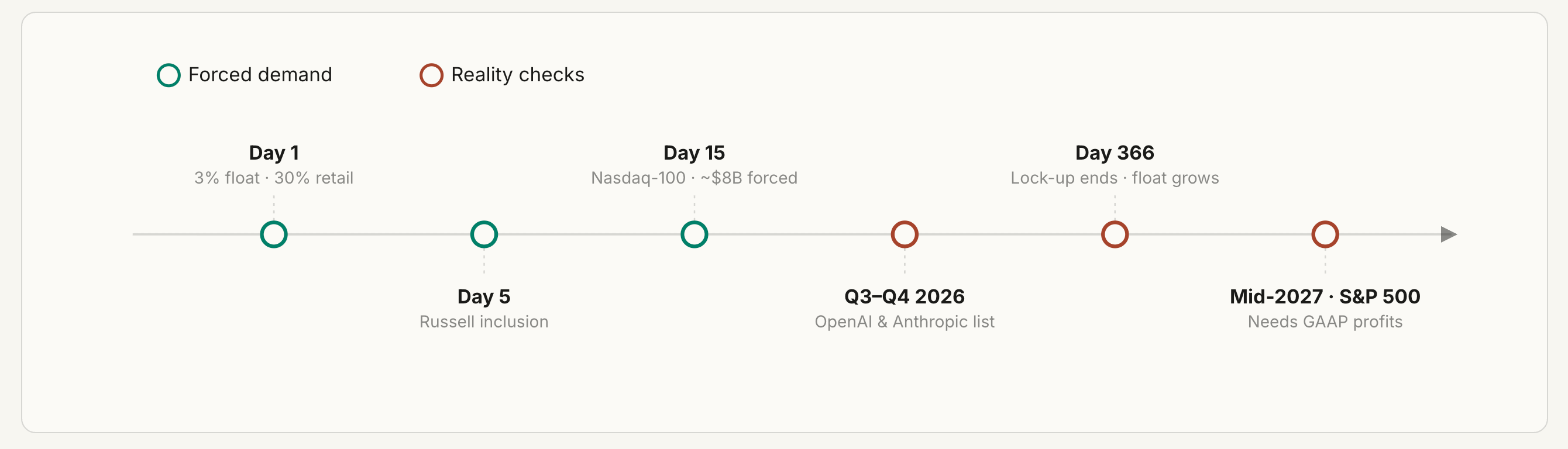
Add the retail wave: SpaceX reserved an unprecedented 30% of the IPO for regular investors (normal is 10%). Demand came in at $150 billion — double the supply — at a fixed price. The overflow doesn’t raise the IPO price. It shows up Friday morning, hitting the buy button.

Massive forced demand. Tiny supply. Almost no shares to borrow, so betting against it is nearly impossible.
This isn’t a hidden trick. It’s all in the filing, in plain sight.
Musk didn’t hide the squeeze. He registered it with the SEC.
The clock
One more layer. The timing is surgical.
Anthropic filed for its IPO on June 1. OpenAI on June 8. SpaceX trades June 12.
Why race to be first by days?
Because right now, there’s no public AI company to compare xAI against. For about one quarter, the market will price Musk’s AI business on pure belief.
The day Anthropic goes public — reportedly with ~$44 billion in revenue and actual profits — investors get a measuring stick. And xAI, at $3.2 billion in revenue and $6 billion of burn, measures badly.
Going first isn’t luck. It’s the whole trade: one quarter of belief before the measuring stick arrives.
The honest part
What can break this:
The price assumes a decade of perfection.
Musk controls 93.6% of the voting power. No independent board. His war, his terms.
If something happens to him, there’s no plan B at this scale.
In 366 days the locked shares flood out. The same scarcity that pumps the price can crash it.
You’re now also a shareholder of Grok and X — with all their lawsuits and drama included.
The real insight
Here’s what makes this IPO unlike anything before it.
In a normal company, hype and reality are separate. Excitement doesn’t build factories.
Here, it does. The belief attracts the capital. The capital buys the gigawatts, the chips, the satellites. The infrastructure makes the belief real. Which attracts more capital.
The story isn’t decoration on top of the business.
The story is the financing of the business.
Musk figured out something nobody else has: you don’t need to win the AI war if you can get the world to fund your purchase of the ground it’s fought on.
That’s not a rocket company. That’s not an AI company.
That’s the first company in history where faith is the balance sheet.
Thanks for reading,
Guillermo Valencia A
The landlord framing is perfect here, love that. Owning the stack from model to orbit means the AI war becomes a tenant relationship. Everyone building intelligence eventually needs the infrastructure underneath it.
The forced buying mechanics are the part worth reading again. $22-30 billion of index demand against $60 billion of available float isnt a hidden edge, its registered with the SEC. The squeeze was filed as a prospectus.
The xAI window before Anthropic goes public is the most surgical part of the timing. One quarter of belief before the measuring stick arrives. After that the comparison becomes unavoidable.