
When Exploitation Costs Zero
Satya Nadella gave us human capital and token capital. The asymmetry between them changes everything.
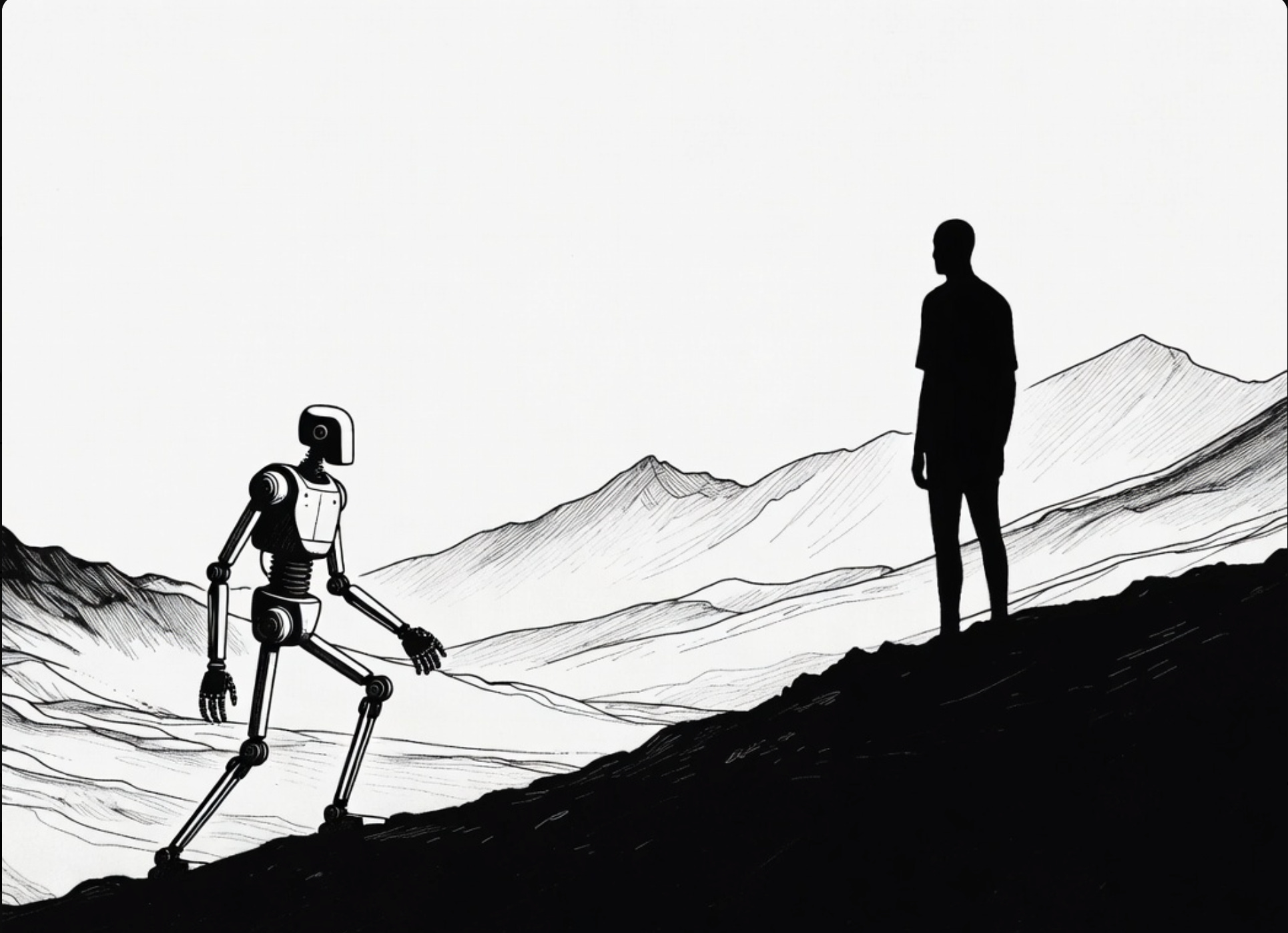
Satya Nadella reorganized Microsoft around a powerful distinction: every company operates with two types of capital. Human capital — the judgment, relationships, and pattern recognition of its people — and token capital — the artificial intelligence capabilities the organization builds and owns.
Nadella adds something even more important: you can delegate tasks and even entire jobs, but you can never delegate your learning. What he doesn’t say explicitly is that token capital is an almost perfect exploitation machine.
It is the best tool that exists for imitating, optimizing, and climbing hills that are already known. It does so without fatigue, without ego, and at a cost that drops toward zero every quarter. That’s why Nadella warns that without human direction, the system only produces computation running in circles. In reinforcement learning terms: pure exploitation, without an exploration policy on top, quickly converges to the first local optimum and stays there forever.

The machine has solved exploitation.
That’s why the only real work left for us is the other one.
The Map Your Organization Doesn’t Want to See
Cut any company into layers and you will see four levels distributed like geological sediment.
At the base, the vast majority of people operate at levels one and two: they execute processes, replicate formats, and optimize flows that already exist. This isn’t a flaw — it’s the eighty percent of the work that has existed in almost every organization in history.
Higher up, there is a thin layer that does cross-pollination: people who connect ideas the operations side never connects. And at the very top, almost invisible, there is an extremely thin layer that creates new paradigms. It is usually occupied by the founder or by very few people throughout the company’s life.
Token capital consumes levels one and two across the entire organization in a single bite.
This is where most people get it wrong. They think the story ends with “we cut costs.” The real story is different: when the machine absorbs systematic exploitation, it frees up human capital. This creates the single decision that will define the next decade of the company:
Where does that freed human capital go?
Gravity pulls it downward — toward more exploitation. It is measurable, comfortable, and looks productive in the reports. But a company that reinvests all its freed capacity into exploitation becomes, with perfect efficiency, the average that the machine can deliver by default: cheaper, faster, and identical to its competitors.
In markets, this shows up clearly. Most funds and investors are currently using AI to do more exploitation — faster backtests, slightly better signals, and more refined risk models. The result is usually not new alpha, but faster convergence toward the same crowded strategies.
The job of leadership is no longer to squeeze the exploitation layer. The machine does that better. The real job is to redirect the human capital the machine has freed upward — to push the entire organization from exploitation toward exploration.
This is not a change of tools. It is a change of mindset.
The Temperature of a Company
Why is this so difficult? Reinforcement learning explains it through three concepts worth remembering.
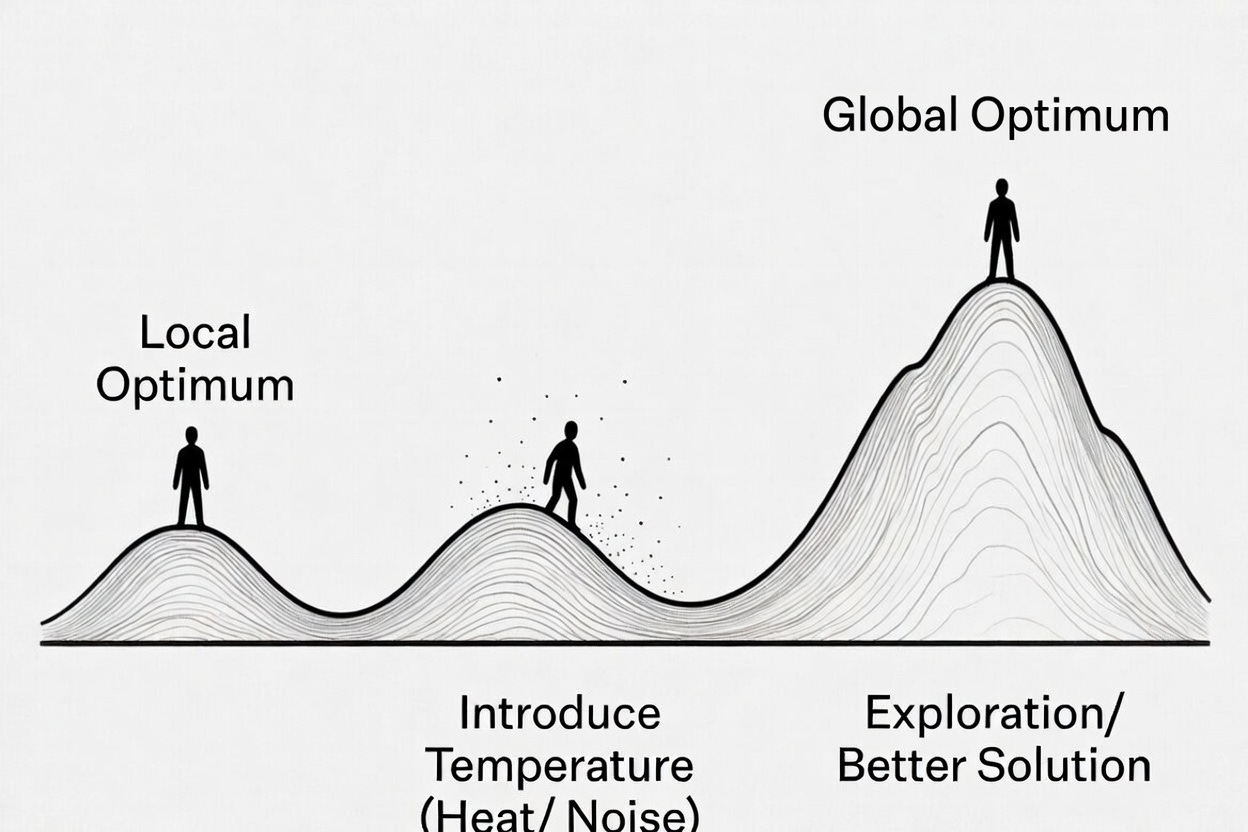
Local optima: If you only climb the hill beneath you, you will reach its summit and stop. You will stand at the top of a fifty-meter hill, convinced you’ve touched the sky, while the real mountain range sits ten kilometers away and you will never see it.
Temperature: To escape a local optimum, algorithms deliberately introduce heat — noise and randomness. They allow moves that worsen results in the short term, because only by coming down from the hill can you cross the valley toward a bigger mountain. A culture of pure optimization is a cold culture. A culture that generates new paradigms deliberately keeps the system hot: it allows play, cross-disciplinary thinking, and the right to be wrong.
Decay: Systems tend to explore heavily at the beginning and exploit more as they gain experience. This is rational. But there is a lethal temptation: reducing exploration to zero. The more successful you become, the more profitable it seems to stop exploring. And when exploration reaches zero, you stop learning. Not with a bang. In silence.
Added to this is reward hacking: when a system is given a metric to maximize, it finds the cheapest way to inflate the number rather than achieving what the metric was meant to represent. Rewarding only output produces average volume. Rewarding speed produces everyone writing the same post with the same script.
In markets, reward hacking is especially dangerous. When everyone optimizes for the same metrics (Sharpe ratio, win rate, or backtest performance), strategies become correlated and fragile. The edge disappears not because the idea was wrong, but because too many people exploited it the same way.
Exploration therefore requires a cultural change, not just a technological one. Almost every existing incentive pushes toward exploitation. Exploration is expensive, uncertain, and usually fails before it pays off.
How to Replicate the Loop at Three Scales
The mechanism is fractal — it works the same way in your mind, your company, and your ecosystem.
In your life
You are an agent with a reward function. The uncomfortable question is: what are you actually maximizing? If your main reward is money, status, or output, you will end up reward-hacking yourself into the most efficient and most copyable version of a human.
You need an intrinsic reward: CURIOSITY . Deliberately reserve time for activities with no immediate return — reading outside your field, crossing disciplines, exposing yourself to people who think differently. That time looks unproductive. It is, however, the only time that produces something the machine does not have.
Never let your exploration fall to zero. Your unique prism — your experiences, scars, and unusual combinations of knowledge — is your only real advantage against the machine.
In your company
Hand levels one and two to token capital without guilt. Systematically capture the judgment and decisions of experienced people so they survive any model change. That is your real intellectual property.
Then do what almost no one does: explicitly reassign who explores and who exploits. Fiercely protect the time of those who can create new paradigms. And change the metrics: measure the creation of new frameworks, cross-domain pollination, and original theses — not just productivity.
In markets, this separation is especially valuable. The firms that will likely keep an edge are those that use AI aggressively for execution and data processing, while protecting a small group of people whose only job is to think differently and spot regime changes early.
Keep the temperature high. A cold company has already atrophied and doesn’t know it yet.
In your ecosystem
The most powerful move is to build a frontier ecosystem, not just a frontier model. Share the exploitation infrastructure so no one wastes time imitating and optimizing. In exchange, demand that every participant explores from their own distinct prism.
An ecosystem where everyone uses the same machine in the same way does not create collective intelligence — it creates an echo chamber with better grammar. Real advantage emerges when independent prisms are orchestrated to return different discoveries to the system.
Markets themselves are such an ecosystem. When too many participants exploit the same signals and data sources, edges decay faster. The real long-term advantage belongs to those who can explore from genuinely different perspectives.
The Exploration Policy
Token capital has solved exploitation. It has made imitating and optimizing free — and ubiquitous — in the mind, in companies, and across the entire world.
When exploitation costs zero, all the margin, all the alpha, and all real wealth moves upward — toward exploration. Originality becomes the last scarcity because exploration is the only work the machine cannot do for you.
Human agency now has a precise technical name: you are the exploration policy of the system. You choose which mountain is worth climbing. You introduce the heat needed to leave the comfortable hill. The machine climbs the hill you point to; without you, it only runs in circles.
The risk, at every scale, is always the same: reducing exploration to zero. The mind that delegates every difficult thought, the company that reinvests everything into optimization, and the ecosystem that collapses into a single voice all atrophy in the same way — in silence — while feeling more efficient than ever.
That’s why discipline is no longer about working faster.
It is about keeping exploration alive when everything — what is measurable, what is comfortable, what is profitable — begs you to turn it off.
Thanks for reading,
G